AI Summaries Are Changing What You Remember: What a New Study Found
You ask ChatGPT to summarise a long article. You read the summary. A day later, you remember the summary — not the article. New research suggests AI summaries do something more troubling than that.
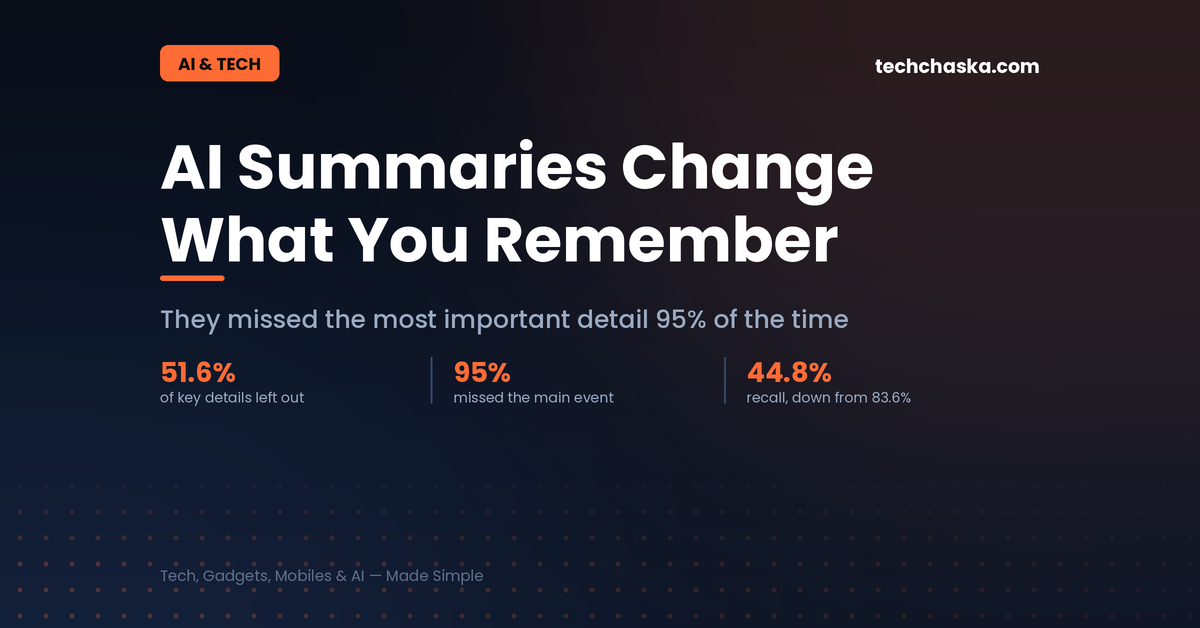
In a study from Georgetown University and the University of Washington, people who read a misleading AI summary answered questions about what they had seen correctly just 44.8% of the time. People who read an accurate summary got 83.6% right.
Same video. Same people, randomly assigned. The AI summaries were the only difference.
Table of Contents
What the study on AI summaries actually did
The researchers — Mattea Sim and Yoshi Kohno at Georgetown, with Yael Eiger at the University of Washington — showed 331 participants short animated videos of a traffic incident: a red car approaching an intersection with a stop or yield sign, then hitting a pedestrian.
Participants then read a summary of what they had watched. Between 24 and 48 hours later, they were tested on what they remembered.
The summaries were not invented by the researchers to be wrong. They were generated by ChatGPT and Gemini — the same tools everyone is using — and then checked against what the videos actually showed.
What the AI summaries left out
This is the part worth sitting with. On average, the AI summaries omitted 51.6% of the central details of what happened.
And 95% of the summaries failed to mention the single most important thing in the video: the car hitting the pedestrian.
Not got it wrong. Did not mention it at all.
That is the quiet failure mode of AI summaries, and it is much harder to catch than a hallucination. When an AI invents a fact, you have something to check. When it silently leaves out the most important thing, there is nothing to notice. The summary reads fine. It is fluent, confident and complete-sounding. You have no way of knowing what is missing unless you go back to the source — which is the exact thing the summary existed to save you from.
What it did to people’s memory
A day or two later, participants were not just less informed. Their memory of the event had shifted to match what the AI summaries said.
| What they read | Answered correctly |
|---|---|
| An accurate summary | 83.6% |
| A misleading summary | 44.8% |
They had watched the video themselves. The summary overwrote it.
Lead author Mattea Sim described AI as “a new method of delivering misinformation”, and argued that we should be thinking much harder about whether AI should be summarising anything where the details matter.
Knowing it came from AI did not help
Here is the finding that should change how you think about this.
Some participants were told their summary was AI-generated. Others were told it was written by a person. All the summaries were actually from ChatGPT.
It made no difference. Being told it came from AI did not protect people from the distortion.
So the common defence — “I know it’s AI, I read it critically” — does not appear to work. Scepticism about the source did not translate into better memory of the facts. Whatever you believe about AI in the abstract, the summary still becomes the thing you remember.
Why this matters more in India than most places
Most Indians are not choosing to read AI summaries. They are being handed them.
That distinction matters. Choosing to summarise something is a decision you can apply judgement to. Being served AI summaries by default is not.
Google’s AI Mode now works in nine Indian languages — English, Hindi, Bengali, Kannada, Malayalam, Marathi, Tamil, Telugu and Urdu — and AI Overviews increasingly answer the question directly instead of showing you links. For a lot of people, the summary is the search result now.
Layer on how people actually use AI here: summarising WhatsApp forwards, news articles, government notifications, long PDFs in a second language. These are exactly the cases where an omission does real damage, and exactly the cases where nobody goes back to check the original.
We wrote recently about Google testing a Buy button inside Gemini and about AI features arriving on phones faster than people can evaluate them. This is the same pattern again: AI is being placed between you and the information before anyone has worked out what it costs.
How to use AI summaries without getting caught out
None of this means stop using them. AI summaries are genuinely useful. It means using them with one rule: match your trust to the stakes.
- Fine to summarise: a long thread you are skimming, an article you are deciding whether to read, meeting notes you were present for.
- Read the original: anything with money, health, legal or safety consequences. Bank notices. Medical information. Government or exam notifications. Contracts and policy documents.
- Ask what is missing. A useful follow-up prompt: “What important details did you leave out of that summary?” It is not a guarantee, but it often surfaces something.
- Be most careful in your second language. If the source is in English and you are reading the summary in Hindi or Tamil, you are least likely to go back and check — which is when omissions do the most damage.
- Do not rely on the AI label. The study is clear that knowing it is AI does not save you.
If you are still deciding which assistant to use day to day, our ChatGPT vs Claude vs Gemini comparison covers what each is actually good at, and our guide to using AI in daily life sticks to the tasks where it genuinely helps.
The Honest Fine Print
The videos were animations, not real footage. Simple animated clips of a traffic incident, not body-camera video or real news. The researchers say so themselves and plan to repeat the work with real police footage. Treat the size of the effect as indicative, not settled.
331 people is a decent study, not a definitive one. It is a solid sample for this kind of psychology research, and it has been presented at a peer-reviewed conference, but it is one study.
The 44.8% figure is for misleading summaries specifically. It is not a claim that all AI summaries halve your recall. The important finding is the one underneath it: that real ChatGPT and Gemini summaries left out half the central details unprompted, which is how a summary becomes misleading in the first place.
This was tested on video, not text. Summarising an article you have read yourself may behave differently from summarising a video you watched. Probably similar, but not demonstrated.
Models change constantly. The versions tested will be superseded. Whether newer ones omit less is not known, and no vendor publishes an omission rate.
Bottom Line
AI summaries are not lying to you. That is what makes this hard to spot. They are leaving things out — 51.6% of central details on average, and the single most important detail 95% of the time — and the result is that you end up confidently remembering a version of events that is missing the point.
Knowing it is AI does not protect you. That is the uncomfortable part, because it is the defence most of us think we have.
Keep using summaries for skimming. For anything that costs you money, affects your health, or you might have to act on, open the original. It takes two minutes, and it is the only thing that reliably works.
FAQ
Do AI summaries actually change what you remember?
In this study, yes. Participants who read a misleading AI summary answered questions about a video they had watched correctly 44.8% of the time, against 83.6% for those who read an accurate summary — tested 24 to 48 hours later.
How much do AI summaries leave out?
The ChatGPT and Gemini summaries in the study omitted 51.6% of central details on average. In 95% of cases they failed to mention the most important event in the video.
Does it help to know the summary is AI-generated?
No. Participants told their summary came from AI were affected just as much as those told it was written by a person. The label did not protect them.
Which AI tools were tested?
OpenAI’s ChatGPT and Google’s Gemini. The summaries came from the tools themselves rather than being written to be wrong.
Should I stop using AI summaries?
No, but match your trust to the stakes. Summaries are fine for skimming and triage. For anything involving money, health, law or safety, read the original document.
Is there a way to catch what a summary missed?
Asking the AI what it left out often surfaces something, but it is not reliable. The only dependable check is opening the source.
Sources: Georgetown University College of Arts & Sciences, Neuroscience News. The paper, “AI-Enabled Human Memory Manipulation”, was presented at the Ninth AAAI/ACM Conference on AI, Ethics and Society in October 2026. Figures are as reported by the researchers.