Is UPI About to Cost You Money? What Actually Changes on 15 October
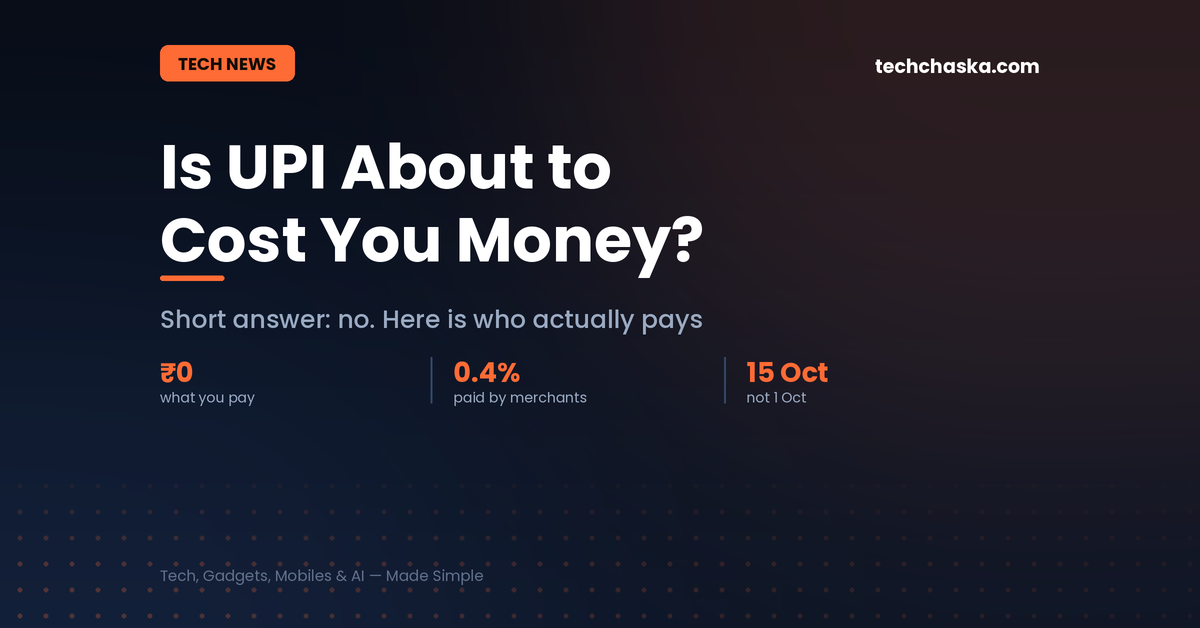
Short answer first, because the panic deserves one: no, you are not about to start paying UPI charges. Scanning a QR code will still cost you nothing on 16 October, whatever your WhatsApp groups are saying this week.
What is actually happening is narrower, and it starts on 15 October 2026 — not 1 October, as several outlets have reported. A 0.4% Merchant Discount Rate begins applying to certain merchant payments above ₹2,000, and it is paid by the merchant.
Here is exactly what changes, who pays it, and the honest part — how it could still reach you anyway.
Table of Contents
What the new UPI charges actually are
The new structure, as set out in NPCI’s own FAQs:
| Transaction value | MDR | Example |
|---|---|---|
| Up to ₹2,000 | Nothing | Your chai, your auto, your kirana bill |
| ₹2,001 – ₹74,999 | 0.4% | ₹3,000 payment → ₹12 | ₹50,000 → ₹200 |
| ₹75,000 and above | Capped at ₹300 | ₹2 lakh payment → still ₹300 |
Some categories get special treatment:
- Railways, telecom, insurance and fuel — a flat ₹5 per transaction above ₹2,000, not 0.4%
- Educational institutions — concessional or capped rates
- Capital markets — 0.02%, capped at ₹300
Who actually pays these UPI charges
The merchant. Not you.
MDR is a fee the business pays out of the payment it receives — the same way card machines have always worked. NPCI’s position is explicit: UPI stays free for individuals, and merchants are not permitted to pass the charge on to customers as a visible surcharge.
So if a shop tries to add “2% extra for UPI” to your bill after 15 October, that is not the new rule. That is the shop breaking it.
What stays completely free of UPI charges
Most of what you actually do with UPI is untouched:
- Sending money to another person — P2P transfers remain free for both sender and receiver, at any amount
- Any merchant payment up to ₹2,000 — which is the overwhelming majority of UPI payments in India
- Small merchants — shops under the P2PM framework receiving up to ₹1 lakh a month through UPI QR pay zero MDR, whatever the transaction size
That last exemption matters more than it sounds. The chaiwala, the vegetable vendor, the small kirana — the people whose QR codes made UPI what it is — are mostly outside this entirely.
The honest part: how UPI charges could still reach you
This is where most coverage stops, and it should not.
NPCI can ban a visible surcharge. It cannot ban a shop from quietly raising prices, trimming discounts, or preferring a payment method. So while you will not be billed UPI charges, the cost does not simply vanish. Industry reaction suggests several routes are likely:
Prices may rise quietly. A direct UPI surcharge is barred. A general price increase is not. Expect the cost to be absorbed into the sticker price rather than itemised on your bill.
Cash discounts may reappear. A shopkeeper doing the arithmetic on a ₹10,000 sale — where 0.4% is ₹40 — may simply offer you a small discount for cash. That is a legal workaround, and a familiar one.
Big UPI payments may get awkward. The Chamber of Trade and Industry has estimated that UPI transactions above ₹2,000 could drop by as much as half as merchants push customers toward cash or cards. That is a trade body’s projection rather than a measured outcome, but petrol dealers did briefly threaten to stop accepting UPI before backing down, so the pressure is real.
Small businesses feel it hardest. On a typical 2.5% net margin, a 0.4% fee is roughly a sixth of the profit on an eligible sale. A hardware shop selling a ₹10,000 item hands over ₹40 — out of around ₹250 of profit. For a shop that size, UPI charges are not a rounding error.
And there is a quieter cost. Digital payment records are what let small businesses prove income for loans. Anything that nudges India back toward cash for larger purchases chips away at that, which is the opposite of what UPI was built for.
What this means for you in practice
- Keep using UPI. For almost everything you do, nothing changes and nothing is charged.
- If a shop adds UPI charges to your bill, question it. Merchants are not permitted to recover MDR from you directly.
- Expect cash discounts on big-ticket items. Not a scam — just a merchant doing the maths. Take it if it is worth more than the record of purchase.
- Keep the digital trail for anything with a warranty. For phones, appliances and electronics, a traceable payment is worth more than a small cash discount when something fails.
- The October sales are unaffected. Amazon’s Great Indian Festival starts 8 October and Flipkart’s Big Billion Days on 9 October — both before this begins, and online checkout is a different arrangement anyway. Our take on the Big Billion Days phone deals covers what to actually buy.
If you follow how taxes and duties move Indian gadget prices, we have also looked at GST on mobile phones and whether phones and EVs are getting cheaper.
The Honest Fine Print
Check the date before you trust an article on UPI charges. We found mainstream coverage dating this to 1 October. NPCI’s FAQs say 15 October 2026. If a piece has the date wrong, treat its other details carefully too.
“Merchants cannot pass it on” is a rule, not a guarantee. Enforcement across millions of small shops is a different matter from writing the rule. Expect inconsistency, especially early on.
The 50% figure is an estimate from a trade body. The Chamber of Trade and Industry has an interest in the number being alarming. Treat it as a lobbying position, not a forecast.
The margin maths is illustrative. The “one-sixth of profit” figure assumes a 2.5% net margin. Real margins vary enormously by category — much thinner in electronics, much fatter elsewhere.
This could still change. Traders have formally asked for a rollback or a higher threshold. Rules of this kind have been revised before launch in India more than once.
We are not financial advisers. This is a description of a published rule change, not advice about your money. For anything involving significant sums, check with your bank.
Bottom Line
From 15 October, merchants pay 0.4% on UPI payments above ₹2,000, capped at ₹300 above ₹75,000, with railways, telecom, insurance and fuel on a flat ₹5 instead. Person-to-person transfers stay free. Payments up to ₹2,000 stay free. Small merchants are exempt.
You will not see new UPI charges on your bill, and if you do, the shop is in the wrong.
What you may see instead is subtler: slightly higher prices, a friendly suggestion to pay cash for the expensive stuff, and a bit more friction on large payments. That is the real story of these UPI charges, and it is a much smaller one than the forwards going around this week.
FAQ
Will I have to pay UPI charges from October?
No. The 0.4% MDR is paid by merchants, not customers. NPCI has stated that UPI remains free for individuals and that merchants cannot recover the charge from you.
When do the new UPI rules start?
15 October 2026. Some reports have said 1 October — that date is wrong.
Are UPI transfers to friends and family still free?
Yes. Person-to-person transfers are free for both sender and receiver, at any amount. The change applies only to certain person-to-merchant payments.
What are the UPI charges above ₹2,000?
0.4% of the transaction, paid by the merchant, on amounts from ₹2,001 to ₹74,999. At ₹75,000 and above it is capped at ₹300. Railways, telecom, insurance and fuel pay a flat ₹5 instead.
Can a shop charge me extra for paying by UPI?
No. Merchants are not permitted to pass MDR on to customers as a surcharge. If a shop adds a UPI fee to your bill, that is not the rule being followed.
Does this affect small shops and street vendors?
Mostly not. Small merchants under the P2PM framework receiving up to ₹1 lakh a month through UPI QR codes pay zero MDR regardless of transaction size, so UPI charges do not reach them at all.
Could these UPI charges still be rolled back?
Possibly. Trade bodies have formally asked for a rollback or a higher threshold, and rules like this have been revised before launch in India before. Nothing has been announced.
Sources: NPCI’s UPI MDR FAQs as reported by SCC Online and Vajiram & Ravi; merchant reaction via Daily Financial. Rates and thresholds are as published at the time of writing and may be revised. Confirm with your bank or payment app for anything significant.