PHEV vs Hybrid vs EV vs Petrol: Which Car Should You Buy in India? (2026)
PHEV vs hybrid vs EV vs petrol — if you’re planning to buy a car in India in 2026 and these terms are making your head spin, you’re not alone. A decade ago the only real question was “petrol or diesel?” Now there are four options, each with confusing names, and every salesperson pushes whichever one they sell. So let me clear it all up in plain, honest language.
In this guide, I’ll explain the difference between PHEV vs hybrid vs EV vs petrol simply, show you the real running costs in rupees, and — most importantly — tell you which one actually fits YOUR driving. No jargon, no sales pitch. By the end, you’ll know exactly which type of car to buy.
The 4 Types Explained in One Line Each
Before the details, here’s the simplest possible summary:
- Petrol: The traditional car. Fill fuel, drive. Cheapest to buy, most expensive to run.
- Hybrid (HEV): Petrol engine + small self-charging battery. Better mileage, no plugging in. Cannot drive far on electric alone.
- Plug-in Hybrid (PHEV): Bigger battery you plug in + petrol engine. Drives 30-60km on electric, then petrol takes over. Best of both worlds.
- Electric (EV): Battery only, no petrol. Cheapest to run, zero emissions, but needs charging.
Now let me explain each properly, because the differences genuinely matter for your wallet.
1. Petrol Cars — The Familiar Choice
You know this one. An engine that runs on petrol. Nothing to plug in, nothing to learn.
Pros: Cheapest to buy, widest choice of models, fuel available everywhere, no range anxiety, simple and cheap to service.
Cons: Most expensive to run (~₹6-8 per km), highest emissions, fuel prices keep rising.
Best for: Buyers on a tight budget, low annual driving (under 8,000 km/year), people in rural areas or small towns without charging infrastructure.
2. Hybrid Cars (HEV / “Strong Hybrid”) — The Smart Middle
A hybrid has a normal petrol engine PLUS a small electric motor and battery. The key thing: you never plug it in. The battery charges itself while you drive (through braking and the engine). At low speeds, the car runs silently on electric; on the highway, the petrol engine kicks in.
Popular examples in India: Toyota Hyryder, Maruti Grand Vitara, Honda City e:HEV.
Pros: Excellent fuel efficiency (often 25+ km/l in the city), no charging needed, no range anxiety, smooth and quiet in traffic, running cost ~₹3-4 per km.
Cons: Costs ₹2.5-4 lakh more than the petrol version, larger strong hybrids attract higher GST (40% vs 18% for smaller ones), can’t drive long distances on pure electric.
Best for: High-mileage city drivers who want fuel savings but CAN’T charge at home. This is genuinely the “smart” pick for many Indian families in 2026 — you get big fuel savings without changing your habits at all.
3. Plug-in Hybrid (PHEV) — The Best of Both Worlds
This is where the confusion peaks, so pay attention. A PHEV is like a hybrid but with a much bigger battery that you plug in and charge (like an EV). This lets it drive 30-60km purely on electric — enough for most people’s daily commute. When the battery runs out, the petrol engine takes over seamlessly, so you never worry about range on long trips.
Think of it this way: your daily office commute runs on cheap electricity (like an EV), but your weekend road trip runs on petrol (like a normal car). No range anxiety, ever.
PHEVs have been rare and expensive in India (mostly ₹50 lakh+ luxury cars), but that’s changing — the upcoming MG Hector Hawk PHEV is expected to bring plug-in hybrid tech to the ~₹20 lakh mass-market segment for the first time.
Pros: Electric driving for daily use (very cheap), petrol backup for long trips (no range anxiety), lower running cost than petrol/hybrid if you charge regularly, great for mixed city + highway driving.
Cons: Most expensive of the hybrid types, you need to actually plug it in daily to get the benefit (if you never charge it, it’s just a heavy hybrid), still relatively few affordable models in India.
Best for: People who want to go electric but have range anxiety, drivers with a mix of city commutes + occasional long trips, and those who CAN charge at home but aren’t ready for a full EV.
4. Electric Cars (EV) — The Future, Available Now
Pure battery, no petrol engine at all. You charge it like a phone and drive.
Popular examples under ₹20 lakh: Tata Nexon EV, Tata Punch EV, MG Windsor EV, Mahindra BE 6.
Pros: Cheapest to run by far (~₹1.5 per km at home charging), lowest maintenance (no engine oil, spark plugs, or clutch), zero emissions, lowest GST (just 5%), instant acceleration, silent.
Cons: Highest upfront price, needs charging access (ideally at home), range anxiety on long highway trips, charging network still patchy outside big cities.
Best for: Urban drivers with home/office charging, high annual mileage (12,000+ km/year), people who mostly drive in the city, and anyone wanting the greenest, cheapest-to-run option.
Running Cost Comparison (The Numbers That Matter)
Here’s the honest per-kilometre running cost in India, roughly:
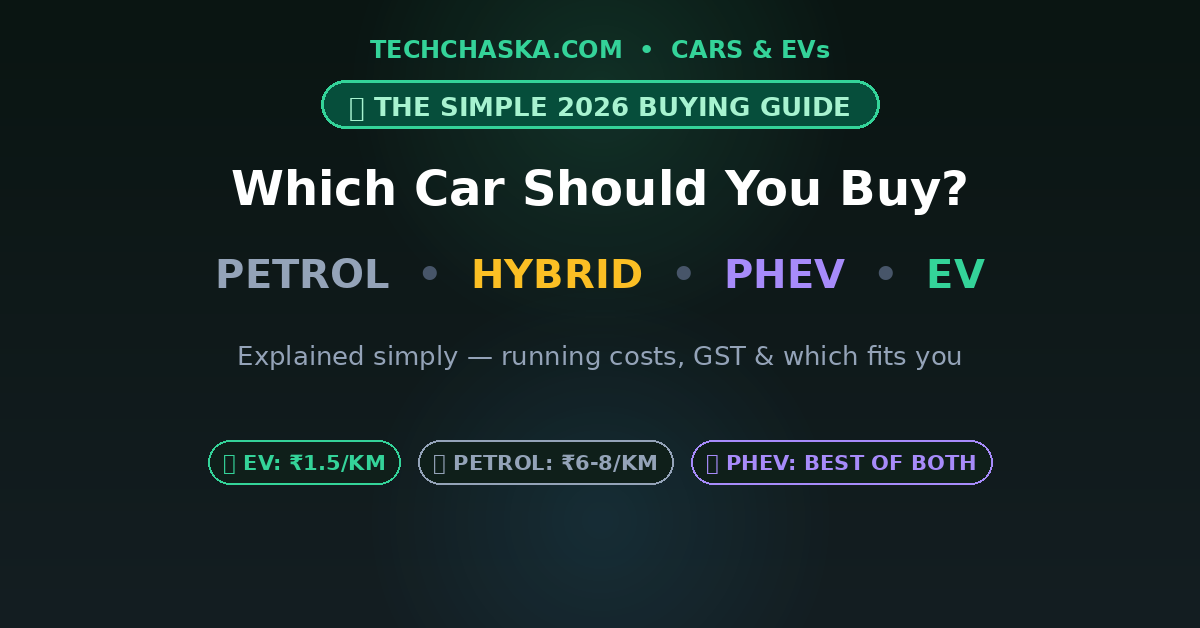
- Petrol: ₹6-8 per km (most expensive)
- Strong Hybrid: ₹3-4 per km
- PHEV: ₹1.5-4 per km (depends how much you charge vs use petrol)
- EV (home charging): ₹1.5-2 per km (cheapest)
So over 10,000 km a year, an EV could save you ₹40,000-60,000 in running costs versus petrol. That difference adds up fast and is the main reason to consider going electric or hybrid.
The GST Angle (Important for India)
One India-specific factor that affects price a lot: GST (tax) differs hugely by type:
- EVs: Just 5% GST — the government is actively pushing EVs
- Small hybrids: 18% GST
- Larger strong hybrids/PHEVs: up to 40% GST
- Petrol cars: up to 28-45% depending on size
This is why EVs, despite higher manufacturing costs, are getting price-competitive — the low 5% GST offsets a lot. And it’s why the government’s other moves, like the recent customs duty cuts on EV battery components, matter for making electric cars cheaper over time.
PHEV vs Hybrid vs EV: Which Should YOU Buy?
Let me make this genuinely simple. Answer these questions:
Can you charge at home or work?
- No → Get a strong hybrid (fuel savings without needing to plug in) or a petrol car if budget is tight.
- Yes → Continue below.
Do you take frequent long highway trips?
- Yes, often → Get a PHEV (electric for daily, petrol for trips — no range anxiety).
- Rarely, mostly city → Get an EV (cheapest to run, perfect for city).
Simple scenarios:
- “I live in a small town, drive little, tight budget” → Petrol
- “I drive a lot in the city but can’t charge at home” → Strong Hybrid
- “I want to go electric but fear long-trip range” → PHEV
- “I have home charging and mostly drive in the city” → EV
The Honest Bottom Line
In the PHEV vs hybrid vs EV vs petrol debate, there’s no universal winner — there’s a best one for YOUR situation:
- Petrol = cheapest to buy, best for low usage and tight budgets
- Hybrid = best fuel savings without needing to charge, great for city drivers
- PHEV = best all-rounder if you can charge AND take long trips
- EV = cheapest to run and greenest, best if you have home charging
My honest take for most Indian buyers in 2026: if you can charge at home, seriously consider an EV or PHEV — the running cost savings are real and add up to lakhs over the car’s life. If you can’t charge, a strong hybrid is the smart middle ground. Petrol only makes sense now if your budget is tight or your usage is genuinely low.
The good news? Every one of these options is getting better and cheaper each year, especially with India’s push on local manufacturing and EV incentives. Whatever you pick, you’re buying at a genuinely exciting time for Indian cars.
Which type are you leaning towards — petrol, hybrid, PHEV, or EV? And what’s your main worry (price, charging, range)? Drop a comment and I’ll help you think it through.
For specific car recommendations, check our guides on the best electric cars under ₹20 lakh and the upcoming MG Hector Hawk PHEV. For the latest auto and tech news, visit our homepage.
Disclaimer: Running costs, GST rates, and prices mentioned are approximate as of 2026 and based on industry sources and general market data. Actual costs vary by model, city, electricity/fuel rates, and driving conditions. This is general guidance to help you choose, not financial advice. Verify current prices and taxes before purchase.