The 10% UPI Discount: Who Can Actually Use It?
Updated 7 October 2026. We published this before vivo announced the V80’s offers, built around a leaked 10% UPI discount that looked uncapped. The prices in that leak were exactly right. The offer was not: vivo announced 10% instant cashback via select banks, with UPI mentioned only for offline purchases and no cap published. We have corrected this piece and left the error visible below.
Paying by UPI instead of a card can be the difference of several thousand rupees on a festive-season phone — in either direction. Most buyers never check which way.
The reason is that a UPI discount and a bank card offer are priced on completely different logic, and the one that wins depends on things nobody puts on the banner: the cap, your card’s network, and your bank’s daily limit.
Here is how to tell which is bigger for you, using this week’s launches as the worked example.
What a 10% UPI discount would actually look like
The vivo V80 launched on 6 October at these prices, which a pre-launch leak had called correctly:
| Variant | Official price | If 10% applied uncapped | Difference |
|---|---|---|---|
| 8GB + 128GB | ₹62,999 | ₹56,699 | ₹6,300 |
| 8GB + 256GB | ₹69,999 | ₹62,999 | ₹7,000 |
| 8GB + 512GB | ₹79,999 | ₹71,999 | ₹8,000 |
Important: the right-hand columns are arithmetic, not vivo’s offer. What vivo actually announced is 10% instant cashback through select banks, plus up to 10% exchange bonus and a one-year extended warranty. Reporting of the offline offer mentions UPI alongside those banks; the online listings describe it as a bank offer. No cap has been published either way. Sales start 13 October.
We have left the table because it shows the thing worth understanding: what a genuinely uncapped 10% would be worth. The saving would keep growing with the price instead of stopping at a ceiling. That is what almost no bank card offer does — and it is why the cap is the number to hunt for.
Why a card offer and a UPI discount are not the same 10%
Amazon’s Great Indian Festival opens on 8 October with 10% instant discount on SBI cards, plus up to 10% extra for Prime members. Flipkart’s Big Billion Days runs from 9 October with Axis and ICICI cards offering “up to 10%”.
Read those two words again: up to.
Card offers in Indian sales are almost always capped — a maximum rupee saving per transaction, written into the offer terms rather than the banner. The banner says 10%. The terms say the most you can save is some fixed figure. On a cheap purchase the percentage binds; on an expensive one the cap does.
We are not going to invent a number for you here, because the caps for this season’s offers are published on the offer pages themselves and nowhere else reliable. That is precisely the point: the cap is the single most important term and it is the one nobody reads. Before you choose a payment method, open the offer terms and find it.
A flat UPI discount with no cap behaves differently. On a ₹20,000 phone the difference between the two may be nothing. On a ₹72,000 one it can be thousands.
The catch: your credit card probably cannot do UPI
Here is the part that catches people out, and it is genuinely under-reported.
UPI runs credit cards only on RuPay. NPCI built credit-on-UPI on domestic rails, and international networks were not integrated as of early 2026. If your credit card is Visa or Mastercard — which most premium Indian credit cards are — you cannot use it on UPI at all.
So for most people, taking the UPI discount means paying from their bank balance. And that quietly costs you things a credit card was giving you free:
- The interest-free period. A card purchase gives you up to about 45 days before the money actually leaves. UPI from your account takes it today.
- Card rewards. Points, cashback and milestone spends on a ₹72,000 purchase are not nothing.
- No-cost EMI. This is usually a card-only facility. Vivo is reportedly offering 24-month no-cost EMI on the V80 — but you generally cannot combine that with paying UPI in full.
- Purchase protection and dispute rights. Chargeback on a card is a stronger position than a completed UPI transfer if something goes wrong.
If you hold a RuPay credit card, none of this applies — you can link it to UPI and collect the discount and the credit together. That is a small but real argument for keeping one.
The limit that will actually stop your payment
Assume you have decided the UPI discount is worth it. There is one more thing that can break the purchase at checkout, and it has nothing to do with offers.
UPI has transaction limits, and a festive-season phone purchase sits uncomfortably close to them.
- NPCI’s standard ceiling is ₹1,00,000, both per transaction and as a daily aggregate across all your UPI apps — on a rolling 24-hour window from your first transaction, not a midnight reset.
- Most major banks — SBI, HDFC, ICICI, Axis, Kotak, IDFC FIRST and others — sit at that ₹1,00,000 daily figure.
- Punjab National Bank caps at ₹50,000 a day. A ₹71,999 payment simply will not go through.
- Regional rural banks run far lower, roughly ₹5,000 to ₹25,000.
- A freshly registered UPI ID is capped at ₹5,000 for its first 24 hours. Setting up UPI on sale morning to grab the discount will not work.
Most people will be fine. But if you bank with PNB or an RRB, or you are planning to set up UPI for this purchase, check before you build your plan around the UPI discount.
So which should you choose?
Take the UPI discount if: you are buying outright, you do not hold the specific partner bank card for that platform, the offer is uncapped or capped above what your card offer gives, and your daily UPI limit comfortably covers the amount.
Take the card offer if: you want no-cost EMI, you hold the partner card and its cap is generous, you value the interest-free period, or your card’s rewards on a large spend are worth more than the difference.
Do the arithmetic once, in rupees. Not percentages. Work out the final figure each way — discount minus any cap, plus the rewards you would earn, minus anything you give up — and compare the two numbers. It takes two minutes and on a phone this expensive it is worth more per minute than almost anything else you will do this week.
One more thing worth knowing: from 15 October, a 0.4% merchant fee begins applying to UPI payments above ₹2,000. It is paid by the merchant, not you, and we have covered what the new UPI rules actually change in detail. It does not affect your discount. It may affect how enthusiastic merchants are about offering these in future.
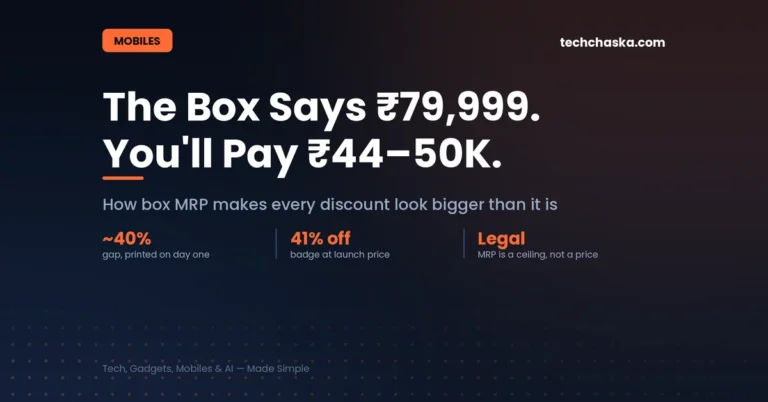
And before you judge any of these offers by the percentage on the badge, our pieces on why box MRP makes discounts look bigger and how to read a festive sale discount cover the number the percentage is measured against. Our running notes on Big Billion Days phone deals track specific models.
The Honest Fine Print
We got the V80’s offer wrong and have corrected it. We published on 6 October describing a leaked flat 10% UPI discount as the live example. The leaked prices were exactly right. The offer was not: vivo announced 10% instant cashback via select banks, not a confirmed uncapped UPI discount. That was our second leak-based error in two days, and we have stopped building headline claims on pre-launch leaks.
We could not verify this season’s exact card caps. Several outlets describe the offers as “up to 10%” without publishing the rupee cap. Rather than guess, we are telling you to look it up on the offer page. If anyone quotes you a specific cap without a source, treat it carefully.
We have not found a confirmed uncapped UPI offer this season. Our original “uncapped” claim was inferred from a leaked price table and did not survive the launch. Flat uncapped UPI discounts do exist in Indian retail, but none of the offers we can verify this week is one. Treat any “10% on UPI” banner as capped until the terms say otherwise.
RuPay-only credit on UPI reflects the position as reported in 2026. Network integration can change. Check your own card’s status rather than assuming.
Bank UPI limits change. The figures here are the widely published ones, but your bank can set a lower sub-limit on your account specifically. Your banking app shows your actual limit.
We are not financial advisers. This is a comparison of payment mechanics, not advice about borrowing. If you are considering EMI on a phone, that is a credit decision and deserves more thought than a sale deadline allows.
No affiliate links, no paid placement. Nobody has paid for a mention here and we earn nothing if you buy.
Bottom Line
A genuinely uncapped UPI discount would be the biggest single saving in this sale, because it would not stop at a cap while card offers do. On a ₹79,999 phone that would be ₹8,000, straight off. The catch is that uncapped offers are much rarer than the banners suggest — we could not confirm one this week.
But it is only available to you if you can actually pay that way — which, if your credit card is Visa or Mastercard, means paying from your bank balance and giving up the interest-free period, the rewards and the no-cost EMI. And it only works if your daily UPI limit is high enough to let the payment through.
Check three things before you choose: the cap on your card offer, whether your card can even use UPI, and your bank’s daily limit. Then pick the bigger number.
FAQ
What is a UPI discount in a festive sale?
An instant price reduction applied when you pay through UPI instead of a card. These are usually capped at a maximum rupee saving, so the headline percentage rarely survives to the top of the price range. Check the cap in the offer terms before choosing a payment method.
Is a UPI discount better than a bank card offer?
Only if it is uncapped, which is rarer than it looks. A flat UPI discount keeps scaling with the price while card offers usually stop at a maximum rupee saving. Both are frequently capped, so the only reliable method is to find each cap in the offer terms and compare the final rupee figure.
Can I use my credit card to get the UPI discount?
Only if it is a RuPay credit card. UPI supports credit cards on domestic RuPay rails only; Visa and Mastercard credit cards cannot be linked. Everyone else pays from their bank account.
What do I give up by paying with UPI instead of a card?
The interest-free period of up to about 45 days, your card’s reward points or cashback, access to no-cost EMI, and the stronger dispute position a card chargeback gives you.
Can I pay ₹72,000 in one UPI transaction?
On most major banks, yes — the standard limit is ₹1,00,000 per transaction and per day. Punjab National Bank caps at ₹50,000 a day and regional rural banks far lower, so the payment would fail there.
Why did my UPI payment fail on a new account?
Newly registered UPI IDs are limited to ₹5,000 for the first 24 hours. The restriction lifts automatically, but it means you cannot set up UPI on sale day to claim a UPI discount on a large purchase.
Do the new UPI charges from 15 October affect my discount?
No. The 0.4% MDR applies to merchants on payments above ₹2,000, not to you, and it does not change any UPI discount being offered to customers.
Sources: Vivo V80 pricing leak via My Mobile India; sale dates and bank offers via 91mobiles and About Amazon India; UPI transaction limits via Razorpay; credit-card-on-UPI mechanics via CardSpot. Leaked prices are unconfirmed. Offer terms change during sales — verify at checkout.