GPT-5.6 Launches July 9: Sol, Terra & Luna Explained + What It Means for India
Okay, quick tech news drop — because if you use ChatGPT, this is worth your attention. OpenAI is launching GPT-5.6 Today, Thursday, July 9, 2026. Sam Altman confirmed it on X yesterday with a three-word tweet: “gpt-5.6 sol launches thursday! happy building.”
But here’s the twist — this launch was almost cancelled. Or at least, seriously delayed. The US government stepped in last month and told OpenAI to slow down over national security concerns. For a few weeks, it looked like GPT-5.6 might only be available to a handful of “vetted partners” indefinitely.
Now it’s back, and there’s a lot to unpack — three different models launching at once, a controversial delay story, real changes in pricing, and questions about what any of this means for Indian users. Let me break it all down honestly.
The Quick Version (If You’re in a Hurry)
- What: OpenAI launches GPT-5.6 publicly on July 9, 2026
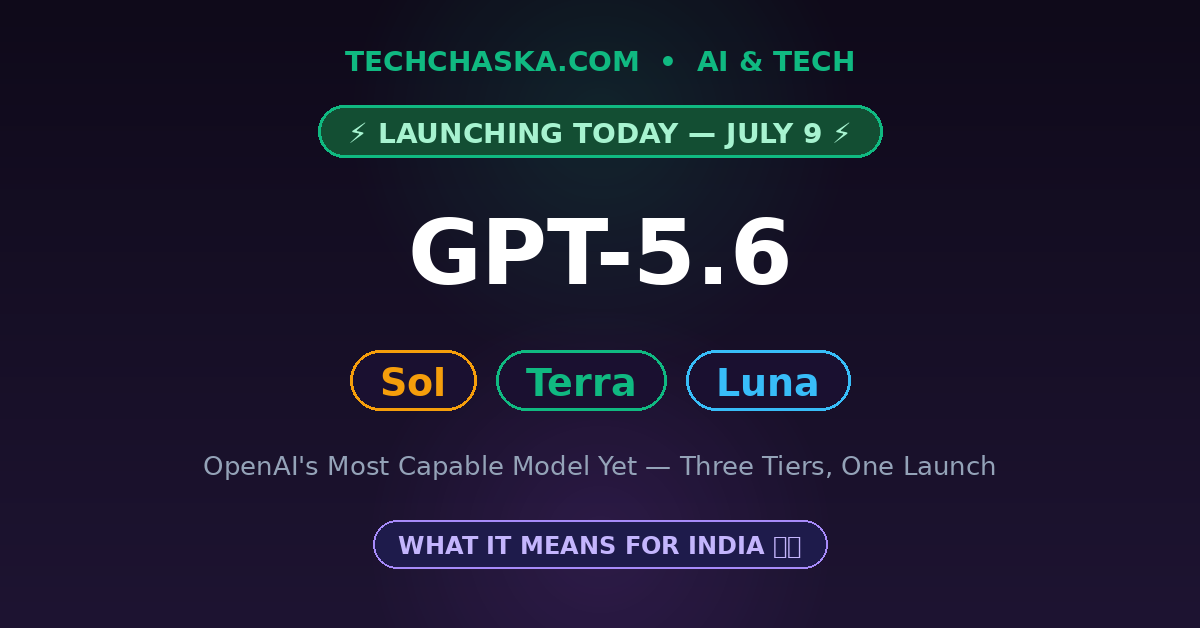
- Three models: Sol (flagship, most powerful), Terra (mid-tier, ~half the price of GPT-5.5), Luna (cheapest, lightweight)
- Why delayed: Trump administration paused it over national security concerns in June
- Why launching now: US Department of Commerce approved after additional government testing
- Key improvements: Better at coding, biology, and cybersecurity tasks
- Competition: OpenAI says Sol is competitive with Anthropic’s Mythos Preview on cybersecurity benchmarks
What Are Sol, Terra, and Luna?
This is the interesting part. Instead of releasing one model, OpenAI is releasing three at the same time — each aimed at a different type of user. Real talk: this pricing tier structure is what Anthropic has been doing with Claude for a while, and OpenAI is now copying that playbook.
GPT-5.6 Sol — The Flagship
Sol is OpenAI’s “strongest model yet,” according to their own blog post. It’s built for the heavy lifting: complex coding projects, deep research, long documents, agentic workflows where the AI does multi-step tasks on its own.
Honest take — Sol is going to be expensive. This is the model OpenAI charges premium pricing for, competing directly with Claude Fable 5 (which is currently in an extended free window until July 12, by the way — we covered that separately).
GPT-5.6 Terra — The Mid-Tier Sweet Spot
Here’s the one I’m most curious about. Terra is designed to be about half the price of GPT-5.5 while offering solid capabilities. If OpenAI actually delivers on that price cut, Terra could quietly become the model most people should use — good enough for 90% of tasks at a fraction of Sol’s cost.
Watch this one closely. Mid-tier models are usually where the real value lives.
GPT-5.6 Luna — The Budget Option
Luna is the fast, lightweight, cheap option. Think: high-volume, simple tasks. Customer service bots. Bulk content processing. Quick summaries. Anything where you need speed and low cost more than raw intelligence.
For developers building apps on the OpenAI API, Luna is probably where a lot of consumer-scale traffic will end up running.
The Delay Story (Why This Almost Didn’t Happen)
This part is genuinely wild, and it matters because it tells you where AI is heading globally.
Back in late June 2026, OpenAI previewed GPT-5.6 and planned a broad launch. Then the Trump administration stepped in and asked them to hold back. The concern? These frontier AI models are getting powerful enough that governments worry about them being misused — for sophisticated cyberattacks, biological research misuse, or being obtained by adversary nations like China or Russia.
So OpenAI limited access to “a small group of vetted partners” whose details were shared with US authorities. Sam Altman even said in an internal memo that this wasn’t OpenAI’s “preferred long-term model” — corporate-speak for “we hate this but we’re going along.”
Then last week, the same thing happened to Anthropic — the US government forced them to disable access to Fable 5 and Mythos 5 for nearly three weeks. Both models were restored only after safeguards were implemented.
Now the Department of Commerce has cleared GPT-5.6 for public release after additional testing under a new “voluntary framework” for frontier AI oversight.
The bigger picture: we’re entering an era where frontier AI models get released on Washington’s schedule, not the company’s. Every big launch from now on will likely go through this kind of security review. Something to keep in mind.
What’s Actually Better About GPT-5.6?
Based on OpenAI’s own preview claims and reporting from multiple outlets, GPT-5.6 improves specifically on:
- Coding: Better agentic capabilities — meaning it can work through multi-step programming tasks more reliably without constant hand-holding
- Biology: Improved scientific reasoning (part of why the government wanted extra testing)
- Cybersecurity: OpenAI claims Sol is competitive with Anthropic’s Mythos Preview on the ExploitBench benchmark — which measures how well AI models can find software vulnerabilities
Notice a pattern? These are exactly the areas that make governments nervous. Better cybersecurity understanding cuts both ways — it can help defenders, but also attackers.
For everyday users like most of us? Honestly, the practical difference between GPT-5.5 and GPT-5.6 for tasks like writing emails, summarizing documents, or planning trips will probably be minor. The big jumps are for developers, researchers, and enterprise use cases.
What This Means for Indian Users
Here’s the India angle — because international tech news often skips this:
1. Availability: Global launches usually reach India same-day or within days. GPT-5.6 should be available on chat.openai.com and the ChatGPT app for Indian users on Thursday. No confirmed staggered rollout.
2. Pricing (best guess): OpenAI hasn’t officially announced Indian pricing yet, but based on the pattern of their previous launches:
- ChatGPT Free: Likely gets limited GPT-5.6 Luna access (as a teaser)
- ChatGPT Plus (₹1,999/month): Should include Terra access with usage limits
- ChatGPT Pro (₹19,900/month): Full Sol access, higher limits
- API pricing: Terra at ~half of GPT-5.5’s rate is the big story for developers
These are my educated guesses based on OpenAI’s pricing patterns — verify the exact numbers on OpenAI’s official pricing page after Thursday.
3. Practical Indian use cases where Sol will actually matter:
- Coders working on complex projects (Sol’s coding improvements are real)
- Researchers and academics dealing with long documents
- Startups building AI products at scale (Luna’s price makes new economics possible)
- Enterprise teams handling agentic workflows
4. For most Indian users? Real talk — if you use ChatGPT for writing emails, homework help, translation, or general questions, Terra will probably be your sweet spot. Sol is overkill for daily tasks and will likely have strict usage limits even on paid plans.
GPT-5.6 vs Claude Fable 5 — Which One Should You Use?
Since these two are the big frontier models right now, here’s my honest take:
Use GPT-5.6 Sol if: You’re already deep in the OpenAI ecosystem, you rely on GPT for coding, or you need the strongest multi-step agentic behavior.
Use Claude Fable 5 if: You work with very long documents (Claude’s 1-million-token context window is genuinely useful), you prefer Claude’s writing style, or you want it free through July 12 on paid plans.
Use both if: You can afford it and want to compare outputs on important tasks. Different models really do think differently — and having two frontier models to cross-check is a real advantage.
My personal approach: I use Claude for long writing and research, and I’ll be testing GPT-5.6 Sol for coding tasks starting Thursday. Different tools for different jobs.
What Else Is Coming (The Competitive Context)
GPT-5.6’s launch isn’t happening in isolation. The AI industry is in the middle of its biggest capability jump in a year:
- Anthropic: Claude Fable 5 and Mythos 5 are back online after their own government-forced pause
- xAI (Elon Musk): Grok 4.5 is reportedly close to public release
- Microsoft: Just launched its own MAI-Code-1-Flash and MAI-Thinking-1 models at Build, positioning itself as less dependent on OpenAI
- Chinese models: Increasingly closing the performance gap at a fraction of the cost
The commercial stakes are enormous. Both OpenAI and Anthropic are reportedly heading toward public listings with valuations approaching $1 trillion. Every launch, every delay, every capability claim now moves billions of dollars.
For us as users, this competition is actually good news. More models means more choice, faster capability improvements, and — usually — falling prices over time.
Should You Care About This Launch?
Honestly? Depends on how you use AI.
If you use ChatGPT casually — for messages, quick questions, occasional writing help — GPT-5.6 is fine to try, but you’re not missing much if you skip it. Free tier will feel similar.
If you use ChatGPT for work or business — try Terra when it launches. The lower cost combined with meaningful capability improvements could actually change your workflow economics.
If you’re a developer or building AI products — this launch matters a lot. Watch API pricing on Thursday, especially Terra’s half-price positioning. This could shift entire product roadmaps.
If you’re an Indian student, freelancer, or professional — the free tier improvements are probably where you’ll notice things first. New to AI in general? Start with our complete ChatGPT beginner’s guide first.
Bottom Line
GPT-5.6 launches Thursday, July 9. Three models — Sol, Terra, Luna. Better coding, biology, cybersecurity capabilities. Terra promises about half the price of GPT-5.5, which is a big deal if it holds up. And the whole thing happened only after the US government reviewed it — a sign that frontier AI launches are entering a new regulated era.
My suggestion: don’t rush to switch anything Today. Wait a week, read real user reviews, test it yourself with your actual tasks. Hype cycles come and go — what matters is which model actually makes your work better.
Will you be trying GPT-5.6? Are you Team OpenAI or Team Anthropic — or, like me, Team Both? Drop a comment below.
For more AI news and honest reviews, check out our coverage of Claude Fable 5’s free access extension, our roundup of the best free AI tools in 2026, and if you want to earn from all this, 10 real ways to make money with AI.
Disclaimer: This article is based on OpenAI’s official announcements and reporting from Reuters, Axios, and other outlets as of July 8, 2026. Model specifications, pricing, and availability may change at launch. Indian pricing figures mentioned are educated estimates based on OpenAI’s existing pricing patterns — verify final pricing on OpenAI’s official website after the July 9 launch.