ChatGPT Just Got a New Voice: GPT-Live-1 Explained + How to Use It in India
Okay, quick one — and if you use ChatGPT on your phone even occasionally, this actually matters. OpenAI quietly rolled out something today that changes how voice conversations with AI work.
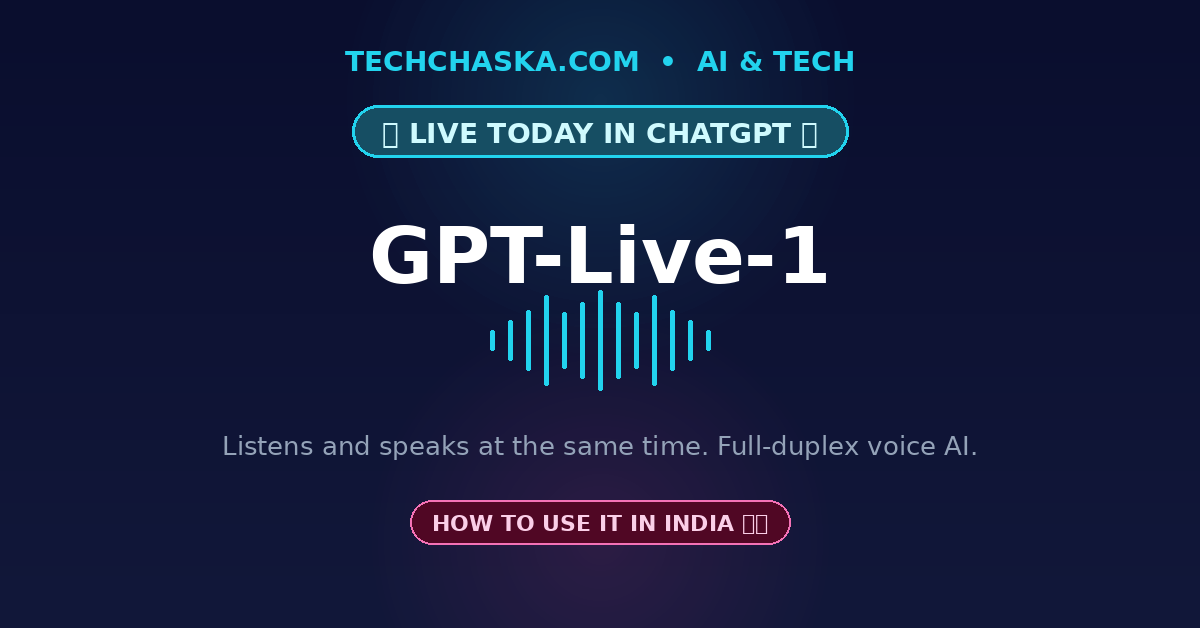
It’s called GPT-Live, and it’s OpenAI’s new voice model family. If you tap the little voice icon in ChatGPT starting today, you’re already using it. The old “Advanced Voice Mode” is gone. Replaced. Both free and paid users are getting this — the free tier gets GPT-Live-1 mini, paid users get the bigger GPT-Live-1.
The tagline sounds like marketing fluff — “it makes talking with AI feel like a real conversation” — but there’s something genuinely different under the hood. Let me break down what actually changed, how to use it, and whether it’s worth the hype.
The One-Line Version
ChatGPT can now listen and talk at the same time. That’s it. That’s the headline.
Old ChatGPT voice worked like a walkie-talkie — you had to finish speaking, then it would respond. Awkward silences. It couldn’t tell if you paused to think or if you were done. Sometimes it interrupted you mid-thought. Sometimes it waited forever.
New GPT-Live works like a phone call. You can interrupt it. It says “mhmm” while you’re talking. It shuts up when you’re thinking. It picks up context in the background. Real-time. Natural.
That single architectural change — called “full-duplex” if you want the fancy term — makes voice AI actually feel usable for the first time.
What Actually Changed (Compared to Advanced Voice Mode)
Here’s the honest breakdown of what’s new:
1. It Listens While It Talks
This is the big one. You can interrupt ChatGPT mid-sentence and it just… adjusts. It’s not confused. It doesn’t restart. It handles it like a human would in a conversation.
Real-world use: You ask a question, ChatGPT starts giving a long answer, you realize you asked wrong, you say “wait, actually…” — it stops and listens. This used to be genuinely painful before.
2. It Handles Silence Properly
Old voice mode would jump in every time you paused. Cough? It responds. Take a sip of chai? It responds. Now if you ask GPT-Live to hold on, it holds on. If you need 10 seconds to think, it just waits patiently. Honestly, this alone makes it more usable.
3. Live Translation Actually Works
Because it processes speech continuously, it can now translate in real time — you speak in Hindi, it translates to English while you’re still talking. Not perfect, but a huge step up from turn-based translation.
4. Nine Remastered Voices
OpenAI remastered all nine ChatGPT voices for this launch. They sound less robotic — more like natural human intonation. Give the new voice options a try; they’re noticeably better than before.
5. Three Reasoning Levels
New feature: pick how hard you want ChatGPT to think.
- Instant: Quick replies, perfect for casual chat
- Medium: Balanced speed and depth
- High: Slower, more thorough — for real questions
This is genuinely useful. Not every question needs deep thinking; not every question deserves a quick shrug.
6. It Can Show You Things Too
While you’re talking, ChatGPT can now surface visual cards — weather, stocks, sports scores — right in the app. So voice isn’t purely audio anymore; it’s audio-first with visual assist when useful.
How to Use GPT-Live in India
You already have access. Here’s how:
- Open the ChatGPT app on your phone (iOS or Android)
- Tap the voice icon (the waveform button at the bottom)
- Start talking
That’s it. If you’re a free ChatGPT user, you’re using GPT-Live-1 mini. If you’re on ChatGPT Plus or Pro, you’re on the full GPT-Live-1 with the extra reasoning levels.
Also works on chat.openai.com in your web browser, but honestly, this is really a phone feature. Voice makes way more sense when your hands are busy.
Practical uses for Indian users
Real talk — the moment I saw the features, these came to mind:
- Language practice. Practice English conversation with an AI that actually keeps flow. Big for students preparing for interviews or IELTS.
- Cooking with your hands full. “Set a timer, and what temperature do I bake this at?” without touching your phone.
- Long commutes. Metro rides where you can have a proper 20-30 minute conversation about something you’re learning — coding, business, current events.
- Explanation on the go. Walking somewhere and want to understand something quickly? Just ask.
- Live translation with elderly relatives. If you have English-speaking guests and Hindi/regional-language family, this could genuinely help.
What About the Numbers?
OpenAI published its own benchmark results (take with reasonable salt, since they’re marking their own homework):
- In head-to-head human tests, GPT-Live-1 was preferred over Advanced Voice Mode 75.7% of the time
- GPT-Live-1 mini was preferred 69.2% of the time
- On GPQA scientific reasoning: 84.2% (up from 45.3% before)
- On BrowseComp (agentic web search): 75.2% (up from 0.7% — massive jump)
Even if you discount OpenAI’s claims by half, this is a meaningful upgrade. Real people preferred the new voice model in the majority of tests. That matches what most early users are reporting on social media too.
The Clever Trick: It Delegates to GPT-5.5 in the Background
Here’s the architectural bit that actually matters for users. When you ask GPT-Live something hard — like “search for the best budget laptops in India right now” — it doesn’t try to answer that itself. It quietly hands the query off to GPT-5.5 (OpenAI’s more powerful model) running in the background, keeps chatting with you naturally, and brings back the answer when it’s ready.
Meaning: you get the smoothness of a fast voice model AND the intelligence of a heavy reasoning model. Best of both.
Fun side effect — as OpenAI releases newer models (like GPT-5.6 which just launched today, we covered separately), GPT-Live can just plug into them without needing an update. Your voice mode gets smarter over time even if the voice model itself doesn’t change.
What’s NOT There Yet (Being Honest)
A few things you should know are missing at launch:
- No API access yet. Developers can’t build with GPT-Live in their own apps yet. OpenAI says it’s “coming soon” but no date.
- No video/screen sharing. Voice only for now.
- Multilingual isn’t full parity. Works well in English; Hindi and regional Indian languages work but aren’t as polished.
- Still delegates for tough stuff. Really complex tasks still need to bounce to GPT-5.5, so there’s a slight delay for hard questions.
None of these are deal-breakers, but worth knowing before you hype yourself up too much.
How This Compares to Google Gemini Live and Meta’s Voice AI
Real talk — OpenAI isn’t alone here. Google’s Gemini Live has similar full-duplex conversation abilities. Meta has been working on voice for WhatsApp and their assistant. Anthropic added voice to Claude last year (though it’s more limited).
Where GPT-Live stands out right now:
- The delegation architecture is genuinely smarter than competitors
- The nine remastered voices sound more natural than Gemini’s currently
- 150+ million people already use ChatGPT Voice weekly, so this reaches the largest audience immediately
But this is a fast-moving space. Gemini Live will improve. What OpenAI has today, others will match in months. What matters is: for now, if you already use ChatGPT, you don’t need to switch anywhere — the best voice AI just landed inside the app you already have.
Honest Take: Is This Actually a Big Deal?
Depends on how you use ChatGPT.
If you barely use voice mode — you probably won’t notice much difference. Text still works fine.
If you occasionally use voice — try it again this week. The improvement is real. You’ll probably use it more often now.
If you use voice regularly — this is a genuine upgrade. Longer conversations feel possible now. Language practice, brainstorming, learning something new while doing chores — all noticeably better.
If you’re a developer — wait for the API. But start thinking about voice-first products, because this makes them feasible in ways they weren’t three days ago.
What This Means Long Term
OpenAI’s product lead literally said in a briefing that he’s had “30-to-40-minute conversations” with ChatGPT during walks. That’s a signal. Voice is going from a novelty feature to a real interface — the same way text chat went from a novelty to a real interface with the original GPT-3.5.
And there are already reports that OpenAI is working on AI-enabled earbuds. If that ships, ChatGPT becomes your always-on voice companion — for better or worse.
For now though, keep it simple: open the app, tap voice, talk. See if the new experience is worth the hype for you.
Bottom Line
GPT-Live-1 is live in ChatGPT globally starting today. Free users get GPT-Live-1 mini; paid users get the full GPT-Live-1. It listens and speaks at the same time, handles interruptions naturally, and delegates hard questions to GPT-5.5 in the background. Nine remastered voices, three reasoning levels, and live translation are the standout new features.
My suggestion: give it 5 minutes of real usage this week. Ask it something conversational, interrupt it, pause and think, let it think. You’ll know within a few minutes whether it’s actually better for how you use it.
Are you a ChatGPT voice user? Or does the whole voice-AI thing still feel weird to you? Drop a comment — genuinely curious.
For more on OpenAI’s AI news, check our full coverage of GPT-5.6’s launch (also today) and our roundup of the 15 best free AI tools in 2026. New to AI in general? Start with our complete ChatGPT beginner’s guide.
Disclaimer: Features, availability, and pricing are based on OpenAI’s official announcements and reporting from TechCrunch, MarkTechPost, and other outlets as of July 9, 2026. Availability may vary by region and account tier. Always verify current features on OpenAI’s official website.