TypeSafe AI: The Surprising $40M Model That Never Chats
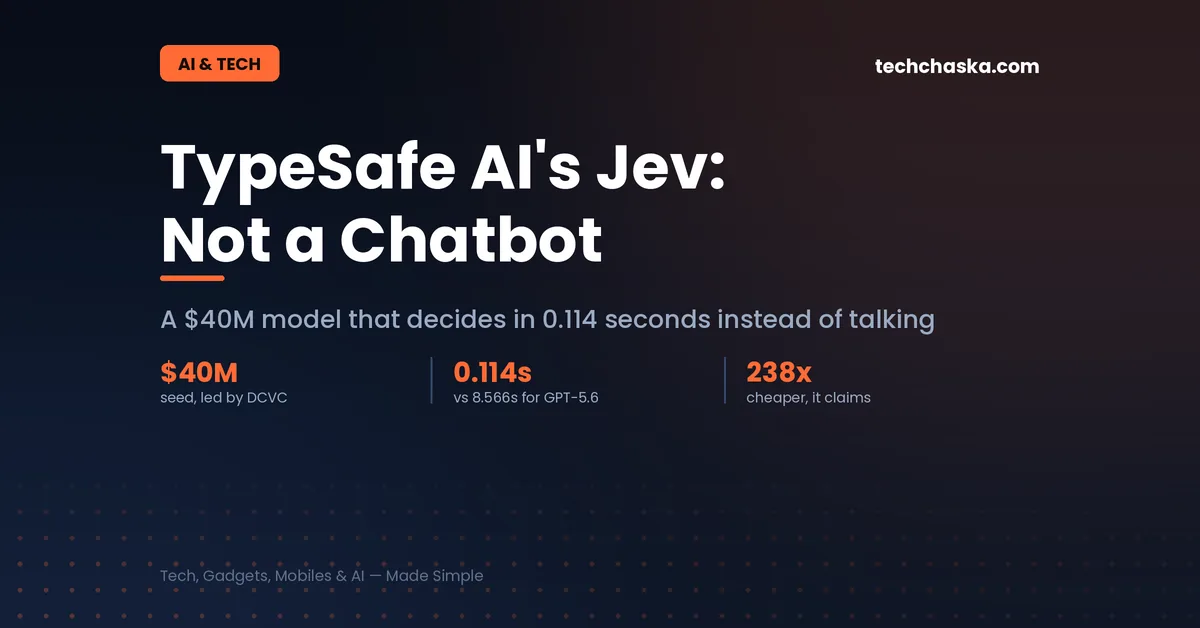
TypeSafe AI came out of stealth on 15 September 2026 with $40 million and a model that is deliberately not a chatbot.
The TypeSafe AI model is called Jev. You cannot have a conversation with it. Ask it something and it does not write you a paragraph — it returns a number, a probability and a confidence score, in under a tenth of a second.
Here is what the company has actually built, why it costs a fraction of what ChatGPT charges, and the objections that are already being raised.
Table of Contents
What TypeSafe AI has built
TypeSafe AI is led by Diogo Almeida, a former OpenAI researcher who was a co-inventor of RLHF — the training technique that made ChatGPT behave like an assistant rather than an autocomplete. He founded the company with Erik Gafni and Sasha Sheng.
The $40 million seed round for TypeSafe AI was led by DCVC.
The pitch is that most AI in production does not need to talk. It needs to decide. Should this refund be approved? Is this ticket billing or technical? Does this output pass the policy check? Those are decisions, and today most software answers them by asking a large language model to write a sentence and then parsing that sentence back into a value.
Almeida’s framing: “Most intelligence should eventually live inside software, running quietly in the background.”
How the TypeSafe AI Jev model works
Jev is what TypeSafe AI calls a “System One” model — a reference to fast, intuitive thinking, as opposed to slow deliberate reasoning. The architecture is named Reinforcement Learning for Calibrated Decisions, or RLCD.
The important difference from an LLM is structural. An LLM predicts one token at a time, in sequence, which is why you watch answers appear word by word. Jev evaluates questions in parallel and returns everything at once.
It exposes three primitives:
- Choice — pick one option from a set, and return probabilities for all of them
- Score — return a score with probabilities and confidence
- Noul — return a 0 to 1 value for how true a statement is
A support-routing call does not come back as prose. It comes back as {"billing": 0.08, "technical": 0.85, "sales": 0.07}. Your code reads that directly. There is no parsing step, and nothing to misinterpret.
Per the documentation, adding more questions to a single call barely changes the response time, because they are evaluated in parallel against the same state.
The TypeSafe AI Doom demo
The launch demo has Jev playing Doom, which is a deliberately silly way to make a serious point about latency.
In the published comparison, Jev returned a decision in 0.114 seconds. OpenAI’s GPT-5.6 Terra took 8.566 seconds on the same task.
A game is a stream of constrained decisions made under time pressure — move, shoot, turn. Eight seconds is useless there. It is also useless for fraud checks at checkout, live content moderation, or routing a call while the customer is still on the line. That is the category TypeSafe AI is aiming at.
Quoted latency across tasks is 70 to 500 milliseconds, which TypeSafe AI puts at 40x to 200x faster than a traditional LLM.
The price difference is the real story
| Model | Input per million tokens | Output per million tokens |
|---|---|---|
| Jev | $0.042 | $0 |
| GPT-5.6 Terra | $2.00 | $12.00 |
Output tokens are described as “too cheap to meter” — which makes sense, because the output is a handful of numbers rather than paragraphs of text.
TypeSafe AI claims Jev costs 238 times less than Fable 5.1 for comparable decision work. Even against GPT-5.6 Terra’s input price alone, that is roughly a 47x gap before you count output at all.
The name is a joke with a point. Jev is short for Jevons Paradox — the observation that when something gets cheaper, total consumption often goes up rather than down.
Why this matters if you are building in India
Inference cost is the quiet reason a lot of Indian AI products stay demos.
If every support ticket, every moderation check and every routing decision costs a few paise in API calls, the maths stops working at Indian price points long before it stops working at American ones. A SaaS product charging ₹499 a month cannot spend ₹80 a month per user on LLM calls.
A model that charges $0.042 per million input tokens and nothing for output changes that arithmetic for the narrow set of tasks it handles. It does not replace ChatGPT — see our comparison of the best AI models in 2026 for what those are actually good at. It replaces the wasteful habit of using a ₹2,000-an-hour consultant to answer yes-or-no questions.
That is a real consideration for anyone in India building on top of AI rather than just using it. If you are still deciding which assistant to use day to day, our ChatGPT vs Claude vs Gemini comparison is the more useful read.
What the sceptics say about TypeSafe AI
The coverage has not been uncritical, which is unusual for a launch this well funded.
The “hallucination-free” claim is doing a lot of work. The Register points out that comparing structured outputs to natural language is not a fair fight. Jev can still return the wrong number. It just cannot ramble.
Someone has to define every question in advance. Stephanie Walter notes that developers must specify the questions, the possible outputs, the thresholds and the escalation paths up front — which she describes as potentially a significant task. The flexibility you lose is the flexibility that made LLMs popular.
A probability is not an explanation. Paul Chada raises the regulatory problem directly: a confidence score shows how sure the model was, not why it decided what it did. For lending, insurance or hiring decisions in regulated markets, that gap matters.
It is a three-day-old company. Advait Patel flags the usual early-vendor risks — security, data residency, service-level commitments and dependency on a startup that may not exist in three years.
David Linthicum’s supportive framing is worth quoting too, because it explains why people are paying attention: enterprises are using general-purpose LLMs as “a universal intelligence layer, even when the application only needs a fast, bounded decision.”
The Honest Fine Print
Nobody outside the company has tested this independently. The latency figures, the cost comparisons and the Doom demo are all TypeSafe AI’s own. No third-party benchmark exists yet.
The comparisons are chosen by the vendor. Benchmarking a decision model against a general-purpose LLM on decision tasks is a fight picked on home ground. That does not make the numbers false, but they are not neutral.
You cannot use it yet. Access is a waitlist at typesafe.ai. There is no public pricing page beyond the quoted token rates, and no self-serve signup.
“Too cheap to meter” is a marketing phrase, not a commitment. Free output today is a launch decision by a company that just raised $40 million. Seed-stage pricing rarely survives contact with a Series B.
This is a developer tool, not a product. If you are not writing software, Jev changes nothing about your day. It sits underneath other products, which is the entire point.
Bottom Line
TypeSafe AI is making a specific and reasonable argument: a large share of what we currently ask chatbots to do is not conversation at all, and paying conversational prices with conversational latency for a yes-or-no answer is wasteful.
If Jev’s numbers hold up under independent testing, the cost gap is large enough to change what is economically viable to build — which matters more in India than in San Francisco.
If they do not, TypeSafe AI is a well-funded team with an excellent pedigree solving a narrower problem than the launch coverage suggests.
Either way, it is worth watching rather than waiting for. Nobody can buy it yet.
FAQ
What is TypeSafe AI?
An AI startup founded by former OpenAI researcher Diogo Almeida with Erik Gafni and Sasha Sheng. It emerged from stealth on 15 September 2026 with $40 million in seed funding led by DCVC, and builds “machine-native” models intended to run inside software rather than answer humans.
Is Jev a large language model?
No. Jev is what TypeSafe AI calls a System One model. It evaluates typed questions in parallel and returns structured decisions with probabilities and confidence scores, instead of generating text one token at a time.
How much does Jev cost?
$0.042 per million input tokens, with output tokens described as too cheap to meter. The company says that is roughly 238 times cheaper than Fable 5.1 for equivalent decision work.
Can I use the TypeSafe AI Jev model right now?
Not openly. Early access is via a waitlist at typesafe.ai. There is no public self-serve signup at the time of writing.
Sources: BusinessWire, The Register, InfoWorld. All performance and pricing figures are the company’s own and have not been independently verified.