Best AI Models 2026: Full Ranking and Which One to Use
Looking for the best AI models in 2026? You’ve picked a confusing year to ask — because there have never been this many strong options. A year ago it was basically ChatGPT vs a couple of rivals. Now there’s Claude, ChatGPT, Gemini, Grok, plus a wave of powerful “open” models from China like Kimi, DeepSeek, and Qwen — and new versions drop almost every week. It’s genuinely hard to keep track.
So let me cut through the noise. This is a simple, honest ranking of the best AI models in 2026 — explained in plain language, not benchmark jargon. I’ll tell you which model is best overall, best for value, best free option, and most importantly, which one you should actually use based on what you need. Let’s rank them.
Quick Answer: The Best AI Models Right Now
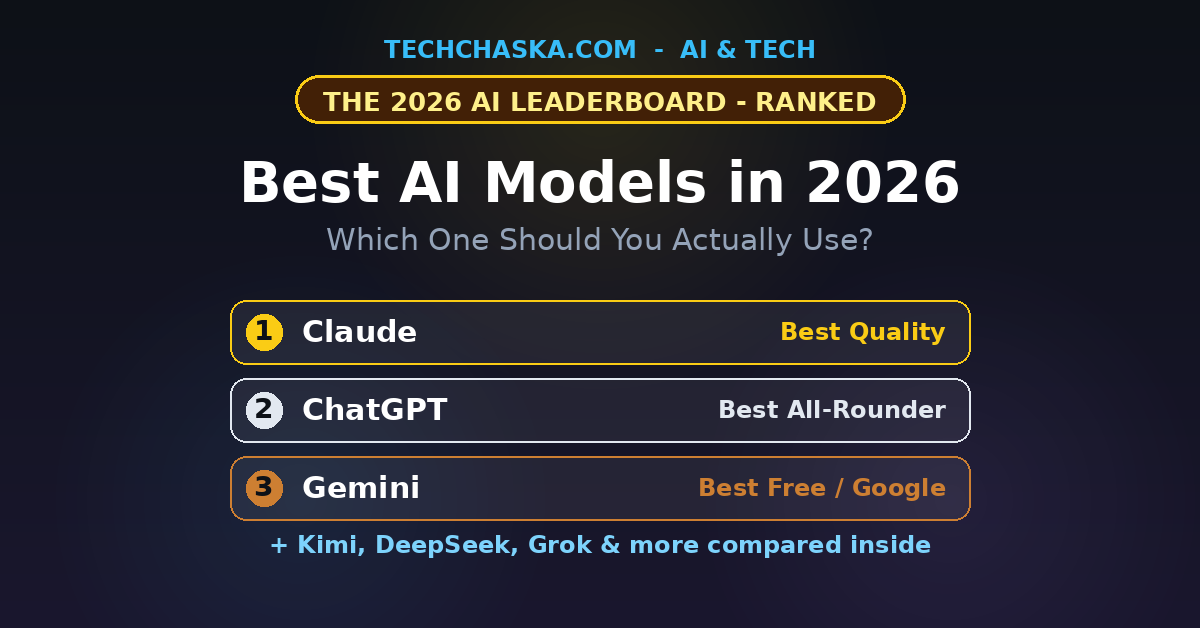
- Best overall quality: Claude (Anthropic) — leads the top independent leaderboards
- Best all-rounder / most popular: ChatGPT (OpenAI)
- Best for Google users & free tier: Gemini (Google)
- Best value at near-top quality: Claude Opus 5 — flagship quality at half the price
- Best open/cheap models: Kimi K3 and DeepSeek V4 — near-frontier performance, tiny cost
- Cheapest top-tier option: Grok 4.5 (xAI)
No single model wins everything. The “best” depends entirely on your use case — so let me break down the ranking and who each one is for.
The 2026 AI Leaderboard (Explained Simply)
Independent testers (like the widely-cited Artificial Analysis index) currently rank the very top of the AI world as an extremely close race. As of July 2026, the frontier looks like this:
- Claude (Fable 5 / Opus 5 tiers) — consistently at or near the #1 spot for overall intelligence and coding
- ChatGPT (GPT-5.6 Sol) — essentially neck-and-neck with Claude at the top
- Kimi K3 — the open model from China that shocked everyone by ranking #3 overall and #1 on some coding tests
- Grok 4.5, Gemini, DeepSeek V4, Qwen 3.7 Max — all strong, trading places just below the leaders
The remarkable part: the top three (Claude, ChatGPT, Kimi) sit within about 3 points of each other on independent tests. The gap between “the best” and “very good” has basically vanished — which is great news for us, because even the cheaper options are now excellent.
1. Claude (Anthropic) — Best Overall Quality
Claude currently holds the crown for overall quality, especially for writing, coding, and complex reasoning. Its latest models (the Fable 5 frontier tier, and the new Claude Opus 5 launched July 24) top the hardest independent benchmarks.
The exciting news: Claude Opus 5 delivers near-flagship intelligence at $5 / $25 per million tokens — about half the price of the previous top tier, with best-in-class coding. That makes premium Claude quality far more affordable than before.
Best for: serious writing, professional coding, long documents, and anyone who wants the highest-quality output. Free tier: Claude’s free plan runs Claude Sonnet 5 with daily limits.
2. ChatGPT (OpenAI) — Best All-Rounder
ChatGPT remains the most popular AI in the world, and its GPT-5.6 models sit right at the top alongside Claude. It’s the best all-rounder — biggest ecosystem, best multimodal abilities (images, voice, video understanding), most app integrations, and the easiest experience for beginners.
Best for: people who want ONE AI that does everything well, beginners, and anyone who needs strong image/voice features. Free tier: ChatGPT Free now defaults to GPT-5.6 with usage limits — genuinely generous.
3. Gemini (Google) — Best for Google Users & Free Access
Google’s Gemini is deeply woven into Gmail, Docs, Android, and Search. If you already live in Google’s world, Gemini fits your workflow with zero friction. It also offers one of the most generous free tiers and has a huge context window (great for long documents).
Best for: students, Google Workspace users, and budget users who want strong AI for free. Free tier: Gemini’s free app runs a fast, capable model at no cost.
4. Claude Opus 5 — Best Value at Near-Top Quality
Worth calling out separately: Claude Opus 5 (July 2026) is the standout “value flagship.” You get near the very best quality for roughly half the cost of the top-tier models. For professionals and businesses who want elite quality without elite prices, it’s arguably the smartest pick of 2026.
5. Kimi K3 & DeepSeek V4 — Best Open & Cheap Models
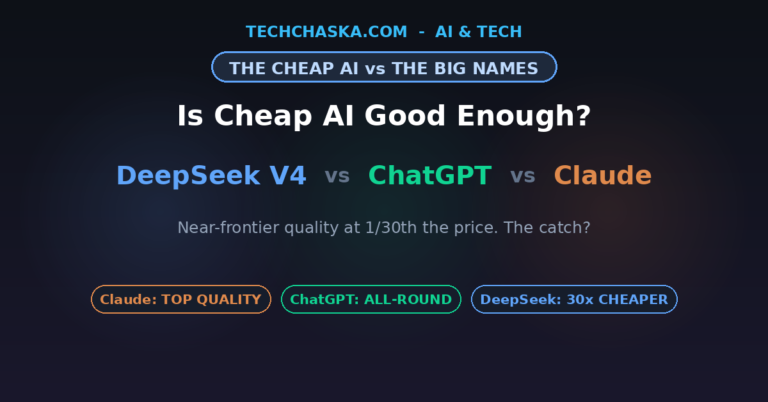
Here’s the biggest story of 2026: open models from China caught up. Moonshot’s Kimi K3 (2.8 trillion parameters) ranks #3 overall and even took #1 on some coding leaderboards — while being far cheaper than ChatGPT or Claude. DeepSeek V4 offers similar near-frontier quality at prices up to 30x lower than the Western flagships.
Both are “open-weight,” meaning developers can download and self-host them for free. The catch: they’re China-hosted by default (a privacy consideration for sensitive business data), and slightly behind the leaders on the hardest tasks.
Best for: developers, startups, and anyone running AI at scale where cost matters. We compared them in detail in our Kimi K3 comparison and DeepSeek V4 comparison.
6. Grok 4.5 (xAI) — Cheapest Top-Tier Option
Elon Musk’s xAI has Grok 4.5, which is competitive with the frontier and notably the cheapest model in the top tier (around $2 per million tokens input). It’s built into X (Twitter) and has a large context window. Testers have flagged a higher tendency to “hallucinate” (state wrong info confidently), so double-check its facts.
Best for: X users, and those wanting frontier-ish quality at the lowest top-tier price.
Which AI Model Should YOU Choose?
Let me make it simple with real scenarios:
- “I want the best quality writing/coding” → Claude
- “I want one easy AI for everything” → ChatGPT
- “I use Google apps all day / want free” → Gemini
- “I want top quality but cheaper” → Claude Opus 5
- “I’m a developer watching costs” → Kimi K3 or DeepSeek V4
- “I want frontier quality at the lowest price” → Grok 4.5
- “I just want free and good” → try ChatGPT, Gemini, or DeepSeek free tiers
The Honest Truth About “Best”
Here’s what the benchmark obsession misses: for 90% of everyday tasks, all the top AI models are excellent and you won’t notice a big difference. Writing an email, summarizing an article, answering questions, planning a trip — any of the top models handles these beautifully.
The differences only show at the edges — the hardest coding, the longest documents, the most complex reasoning. So don’t agonize over picking “the best.” Pick the one that fits your main use and budget, start using it, and switch later if needed. You genuinely can’t make a wrong choice among the top models in 2026.
How to Choose in Practice
- Start with a free tier. ChatGPT, Gemini, and DeepSeek all have genuinely good free versions.
- Match it to your main task (writing → Claude, all-round → ChatGPT, Google → Gemini).
- Only pay when you hit free limits regularly. Then upgrade the ONE you use most (~$20/month).
- Try two at once for important work — asking the same question to two models and comparing often gives a better answer.
Bottom Line
The best AI models in 2026 are closer in quality than ever: Claude leads on quality, ChatGPT is the best all-rounder, Gemini wins for Google users and free access, Claude Opus 5 is the value champion, and Kimi K3 / DeepSeek V4 prove that cheap open models can nearly match the giants. The gap between the best and the rest has shrunk to almost nothing.
My honest advice: don’t chase the #1 spot on leaderboards — it changes every few weeks. Instead, pick the model that fits your actual needs and budget from the scenarios above, start with its free version, and upgrade only when you need to. In 2026, you’re spoiled for choice, and that’s a wonderful problem to have.
Which AI model do you use most, and what for? Do you stick to one or hop between several? Drop a comment — I’m always curious what’s working for people!
Want to go deeper on specific models? Read our comparisons: ChatGPT vs Claude vs Gemini, Kimi K3 vs ChatGPT vs Claude, and DeepSeek V4 vs ChatGPT vs Claude. New to AI? Start with what is AI and how to use it, then see how to use AI in daily life. For more, visit our homepage.
Disclaimer: AI model rankings, benchmark scores, and prices are based on independent sources including the Artificial Analysis Intelligence Index and vendor data as of July 2026. This is one of the fastest-moving areas in tech — rankings and prices change frequently, so always verify current standings from official and independent sources before making decisions. This article is not sponsored and reflects honest analysis.