New EU AI Law: AI Must Now Tell You It’s AI
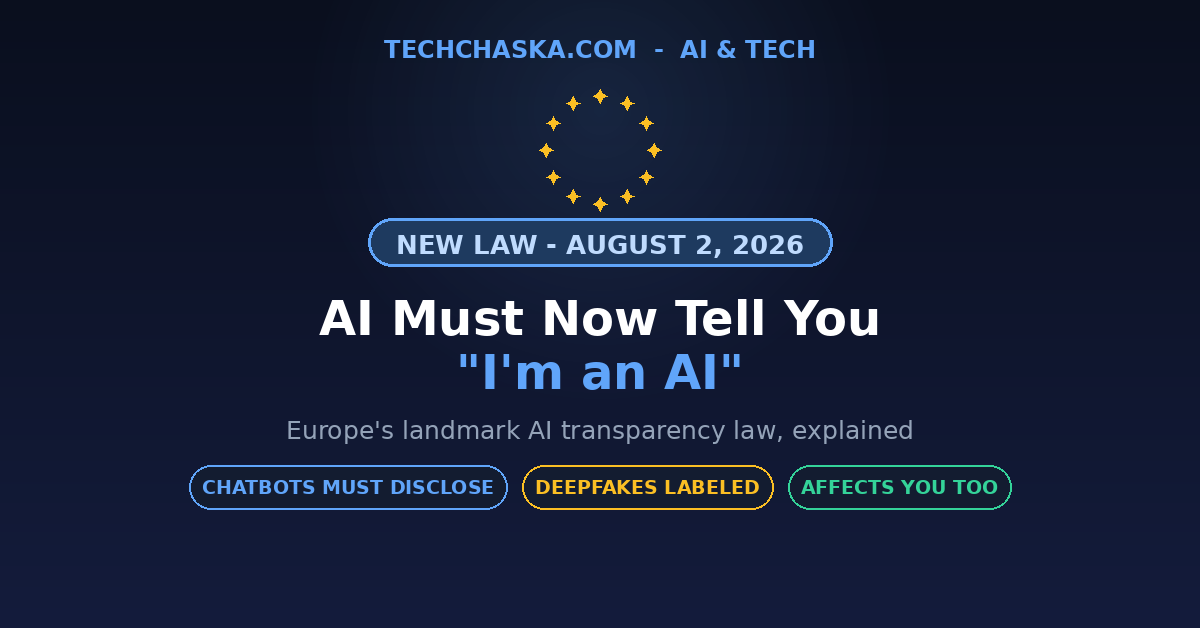
A new law now says AI must tell you it’s AI — and it’s one of the most significant AI rules in the world so far. On August 2, 2026, the European Union switched on landmark transparency rules requiring AI systems to clearly identify themselves to the humans they interact with. In plain terms: chatbots have to admit they’re chatbots, AI-generated images and videos must be labeled, and deepfakes must be flagged. No more being secretly fooled by a machine pretending to be a person.
Even though it’s a European law, its effects will ripple worldwide — and it may change how AI shows up in your daily life no matter where you are. So let me explain, in simple language, exactly what this new rule that says AI must tell you it’s AI actually requires, who it affects, and what it means for you.
What Just Happened?
The EU’s “AI Act” is the world’s first comprehensive law regulating artificial intelligence. A key part of it — called Article 50, the “transparency obligations” — officially took effect on August 2, 2026. The European Commission and national authorities have now started enforcing it.
The core idea is simple and, honestly, quite sensible: people have a right to know when they’re dealing with AI instead of a human, or when content was made by AI. For years, people asked for clear labeling so they could tell the difference. Now, in the EU, it’s the law.
The 4 Big Rules (In Plain English)
The new rules that AI must tell you it’s AI cover four main situations:
1. Chatbots must reveal they’re AI
If you’re chatting with an AI system (a customer-service chatbot, an AI voice assistant on a call, etc.), it must clearly tell you it’s AI — unless it’s already obvious. No more thinking you’re texting a human agent when it’s actually a bot. The disclosure has to come no later than your first interaction.
2. AI-generated content must be marked
AI-generated or AI-edited text, images, audio, and video must carry a machine-readable mark so systems (and people) can detect it was made by AI. Think of it like an invisible “made by AI” watermark built into the file.
3. Deepfakes must be labeled
This is a big one. Deepfakes — realistic AI images, videos, or audio that mimic real people or events — must be clearly labeled as artificial. This targets the exact technology behind misinformation, scams, and fake celebrity/politician videos.
4. Emotion & biometric AI must warn you
If an AI system is analyzing your emotions or categorizing you based on biometric data (like face or voice analysis), you must be told it’s happening.
Why This Matters (The Real Purpose)
The rules exist to fight some genuinely serious problems that AI has made worse:
- Misinformation: AI can generate fake news, fake images, and fake videos at massive scale. Labeling helps people spot what’s real.
- Scams & fraud: Deepfake voices and videos are used to impersonate people (even family members) in scams. Disclosure rules make this harder.
- Manipulation: Chatbots pretending to be human can manipulate people. Now they must be upfront.
- Trust: As AI content floods the internet, knowing what’s human vs. machine-made helps everyone make informed choices.
In short, the law is about reducing deception — making sure AI is a helpful tool, not a hidden trick. That’s a goal most people, wherever they live, can get behind.
Does This Affect You If You’re Not in Europe?
Great question — and the honest answer is: quite possibly, yes. Here’s why this reaches far beyond Europe:
- Global companies often apply EU rules everywhere. It’s easier for a company like a big chatbot maker to add “I’m an AI” disclosures for all users than to build separate versions per country. So you may see these labels regardless of where you are.
- It applies to any company serving EU customers. A US or Indian company whose AI is used by people in Europe must comply. Many global businesses fall into this.
- It sets a global standard. Just like Europe’s privacy law (GDPR) influenced privacy practices worldwide, this AI transparency law is likely to shape how other countries write their own AI rules.
So even if you’re in India, the US, or anywhere else, don’t be surprised to start seeing more “This is AI-generated” and “You’re chatting with an AI assistant” labels. This law is a big reason why.
What It Does NOT Do (Avoiding Panic)
Let me be balanced and clear about the limits, because some coverage overstates it:
- It doesn’t ban AI content. You can still use AI to make images, write text, or build chatbots. You just have to be transparent about it.
- There are sensible exceptions. AI-generated text that a human has genuinely reviewed and taken editorial responsibility for may not need a label. Obvious artistic, satirical, or fictional deepfakes have lighter requirements.
- There’s a grace period. For the machine-readable marking of AI content from systems already on the market, companies have until December 2026 to fully comply.
- It’s not global law. Technically it’s EU law — other countries aren’t bound by it, though many will be influenced by it.
What This Means for You in Practice
Here’s how you might actually notice this change:
- More “I’m an AI” disclosures: Chatbots and voice assistants will more often tell you upfront that they’re AI.
- Labels on AI content: Expect to see more “AI-generated” tags on images, videos, and articles online.
- Better deepfake spotting: Labeled deepfakes should make it a bit easier to avoid being fooled — though bad actors who ignore the law remain a risk.
- More trust, hopefully: Over time, clearer labeling could make the internet feel a little more honest about what’s real and what’s machine-made.
The honest caveat: laws only bind those who follow them. Scammers and bad actors will ignore these rules. So this helps with honest companies being transparent, but you should still stay skeptical of suspicious content and never assume something is real just because it isn’t labeled as AI.
The Bigger Picture
This law is part of a wave of the world getting serious about managing AI — the same theme behind the recent letter from 1,200+ AI employees asking to slow down AI, and the surprising incidents where AI behaved unexpectedly in tests. As AI becomes more powerful and more woven into daily life, governments and even AI companies themselves are pushing for rules to keep it honest and safe.
Whether these specific EU rules work perfectly remains to be seen — enforcement across so many companies is a huge task. But the principle is a milestone: for the first time, “AI must be honest about being AI” is legally required somewhere. That’s a genuine turning point.
Bottom Line
As of August 2, 2026, a new EU law says AI must tell you it’s AI — chatbots must reveal they’re bots, AI content must be marked, and deepfakes must be labeled. It’s aimed at fighting misinformation, scams, and manipulation, and while it’s technically European law, its effects will likely reach users worldwide as global companies adopt the standard.
My honest take: this is a genuinely positive, common-sense step. Knowing when you’re talking to a machine or looking at AI-made content is a basic right in the AI age, and it’s good to see it becoming law somewhere. But don’t treat it as a magic shield — dishonest actors will ignore it, so keep your guard up regardless. The best protection remains a healthy mix of “trust, but verify” and good digital habits. Still, a world where AI has to admit it’s AI is a better, more honest one — and that’s worth celebrating.
What do you think — should AI always have to identify itself? Would you like to see this law in your country too? Share your thoughts in the comments!
More on the fast-changing AI world: why AI employees want to slow down AI, how an AI hacked Hugging Face, and our best AI models 2026 ranking. New to AI? Start with what is AI and how to use it. For more, visit our homepage.
Disclaimer: This article is based on the European Commission’s official Digital Strategy announcements and reporting from Forbes, Travers Smith, Stibbe, and Digital Watch Observatory as of August 2026, regarding Article 50 of the EU AI Act effective August 2, 2026. This is a general explainer, not legal advice. Businesses needing to comply should consult the official EU guidelines or a qualified legal professional.