AI Phone Features in India: Why 89% Buy For Them and Only 30% Get Them
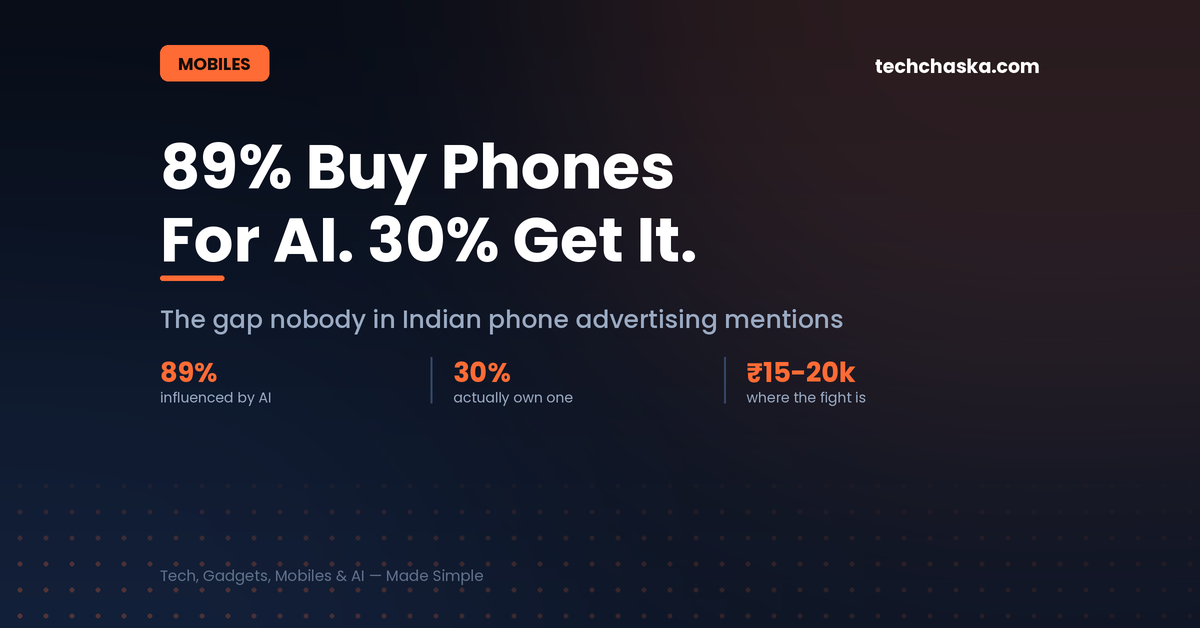
Here is a number worth sitting with: 89% of Indian smartphone buyers say AI phone features influence what they buy. Only about 30% actually own a phone that can run them.
Both figures come from the same study — a Flipkart and Counterpoint Research report on Indian smartphone buying, published earlier this year. Nearly nine in ten people are choosing a phone partly on AI. Fewer than one in three end up holding one that does AI properly.
That gap is the most honest thing anyone has said about AI phone features in India all year, and nobody seems to want to talk about it. So let us.
Table of Contents
What the data says about AI phone features in India
The report surveyed Indian buyers on what drives a phone purchase, and AI phone features came out near the top. The headline numbers:
- 89% say AI features influence their purchase decision
- 30% have actually adopted a GenAI-capable device
- 60% put value for money first, ahead of brand trust (57%) and online reviews (56%)
- 57% will pay more for a better camera; 45% will pay more for performance
- 33% now use EMI to reach a phone they could not otherwise afford
- Replacement cycles have stretched from around 3.5 years to nearly four
And the detail that explains everything else: the segment both brands are fighting hardest over is ₹15,000 to ₹20,000.
Hold those two facts together. The AI marketing is aimed at the ₹15–20k buyer. The AI hardware mostly is not.
Why the gap exists: AI phone features need hardware you are not buying
There are two completely different things being sold as AI phone features, and the ads work hard not to distinguish between them.
On-device AI runs the model on the phone itself. It works without a signal, keeps your data local, and responds instantly. This is the version worth paying for.
Cloud AI sends your request to a server and waits for an answer. It needs data, it is slower, and your content leaves the device. This is what most “AI phones” are actually doing.
The hardware bar for real on-device AI is high and getting higher. Google’s current on-device tier is reported to need 12GB or more of RAM and a current flagship chipset — a bar that reportedly locks out phones as recent as the Pixel 9 and Galaxy S25. Not budget phones. Last year’s flagships.
A ₹17,000 phone typically ships with 6GB or 8GB of RAM and a mid-tier chip. It is not running a local language model, whatever the box says.
What ₹15,000 to ₹20,000 actually buys you in AI
This is not nothing. It is just much smaller than the marketing implies. At this price, AI phone features usually mean:
- Camera processing — scene detection, night mode, portrait edge detection. Genuinely useful, and genuinely AI, but it has been in phones for years under a new name.
- Photo editing tricks — object erase, sky replacement. Often cloud-processed, so they need a connection and an upload.
- An assistant app — Gemini or similar, running almost entirely in the cloud. The same thing you can install on any phone.
- Battery and thermal management — real, quietly valuable, never advertised.
What you generally do not get: offline summarising, on-device transcription, live translation without a signal, or anything that keeps sensitive content off a server.
If you want to know where the real money goes in this segment, our guide to the best phone under ₹20,000 in India ranks what these phones actually deliver.
Which AI phone features are worth paying for
A simple filter for sorting real AI phone features from branding, since the spec sheets will not help you.
| Feature | Worth it? |
|---|---|
| Camera processing and night mode | Yes — you use it every day |
| On-device transcription or summarising | Yes, if you genuinely need it offline |
| Cloud photo editing | Maybe — free apps do much of it |
| A bundled AI assistant | No — it works on almost any phone |
| “AI” in the product name | No. It means nothing on its own. |
The one question worth asking in the shop: does this feature work in flight mode? If yes, it is on-device and the hardware earned its price. If no, you are paying a hardware premium for a cloud service that would run on a cheaper phone.
How people in India actually use AI phone features
The report found that use of AI phone features splits sharply by who you are. Gen Z leans on AI for content creation and entertainment. Millennials use it for productivity and planning. Women in the survey used it most for everyday assistance and lifestyle needs.
Notice what is missing from all three: nobody’s most-used feature is the one on the billboard. People use AI phone features for small, repetitive things. That is an argument for buying a phone that is fast and lasts, not one with the longest feature list.
Much of what people describe wanting is not phone-specific at all — it is a good assistant, which runs just as well on a cheap phone through an app. Our ChatGPT vs Claude vs Gemini comparison is the more useful read if that is what you are really after, and the best AI models of 2026 guide covers which is strongest at what.
There is also a quieter finding worth noting: 64% prefer a colourful phone, and buyers will pay around 5% more for a colour they like. People will pay real money for a colour. Which tells you something about how much of a phone purchase is actually about the spec sheet.
What this means before the October sales
The timing matters. Amazon’s Great Indian Festival starts 8 October and Flipkart’s Big Billion Days starts 9 October, with early access a day earlier for Plus members. Amazon has confirmed a 10% instant discount on SBI cards; Flipkart’s bank partners vary year to year, so check before you commit to a card.
During those two weeks, AI phone features will be the most-pushed selling point in Indian phone advertising. Go in knowing the 89-versus-30 gap and most of it stops working on you.
Practical version:
- If your budget is under ₹20,000, buy on camera, battery and processor. Treat AI phone features as a bonus, not a reason.
- If on-device AI genuinely matters to you, you are looking at a flagship, and you should confirm the exact RAM and chipset rather than trusting the phrase “AI-powered”.
- With replacement cycles now near four years, a slightly better processor is worth more than a longer feature list. You will live with this phone a long time.
- If you are weighing whether to buy now or hold out, our take on the Big Billion Days 2026 phone deals goes through the maths.
The Honest Fine Print
The survey is a few months old. It was published earlier in 2026. The 30% GenAI ownership figure will be higher by now — adoption moves fast. The direction of the gap is what matters, not the exact decimal.
“GenAI-capable” is a fuzzy category. Different analysts draw the line differently. Treat 30% as a reasonable estimate, not a hard threshold.
The hardware requirements are reported, not official. The 12GB RAM and flagship-chipset bar comes from coverage of Google’s on-device tier rather than a specification page. Requirements also differ between Google, Samsung and Apple. Check the exact model before you buy on this basis.
Flipkart commissioned the research. Counterpoint is a credible firm and the numbers look sound, but a report funded by India’s largest phone retailer will naturally emphasise what drives sales. Read it with that in mind.
Cloud AI is not useless. It is often better than on-device, because the models are larger. The objection is not that cloud AI is bad — it is being sold as a hardware feature when it is a service, and priced as though the chip were doing the work.
Bottom Line
Indians are buying phones for AI phone features at a rate that has clearly surprised the industry — 89% say it shapes their decision. But the phones most people can afford, in the ₹15,000 to ₹20,000 band where the real fight is, largely cannot run the AI being advertised to them. Only around 30% own a device that can.
That is not a scandal. It is a marketing gap, and it closes over the next two or three years as the hardware needed for real AI phone features gets cheaper.
Until then, the useful move is unglamorous: buy the phone with the better camera, the better battery and the faster chip. The AI worth having will arrive on your next phone, and with cycles now stretching to four years, you will be keeping this one long enough for that to be the right call anyway.
And if a feature does not work in flight mode, you are paying for a subscription someone forgot to charge you for.
FAQ
What are AI phone features?
They cover two different things: on-device AI, where the model runs on the phone’s own chip, and cloud AI, where the request is sent to a server. On-device works offline and keeps data local. Most AI marketed on mid-range phones is cloud-based.
Do AI phone features work on phones under ₹20,000?
Partly. Camera processing, scene detection and battery management are real and work well at this price. Offline summarising, on-device transcription and local language models generally need 12GB or more of RAM and a flagship chipset, which phones in this band do not have.
Why do only 30% of Indians own a GenAI phone?
Because the hardware sits mostly in flagships while the volume sits at ₹15,000 to ₹20,000. The Flipkart and Counterpoint report found 89% of buyers are influenced by AI features but only around 30% own a device capable of running them.
How can I tell if a phone’s AI phone features are on-device or cloud?
Turn on flight mode and try the feature. If it still works, it is running on the phone. If it fails or asks for a connection, it is a cloud service and does not require the hardware you are paying for.
Should I wait for the October sales to buy an AI phone?
Amazon’s Great Indian Festival starts 8 October and Flipkart’s Big Billion Days on 9 October, so waiting a week or two is usually sensible if you are not in a hurry. Just judge the phone on camera, battery and processor rather than on the AI branding, which will be everywhere during the sale.
Sources: Counterpoint Research × Flipkart India Smartphone Buyer report, Business Standard, FoneArena for sale dates. Survey figures are as reported; hardware requirements for on-device AI are based on published coverage and may vary by manufacturer and model.