OpenAI Cursor Cutoff: Models Stop on November 12
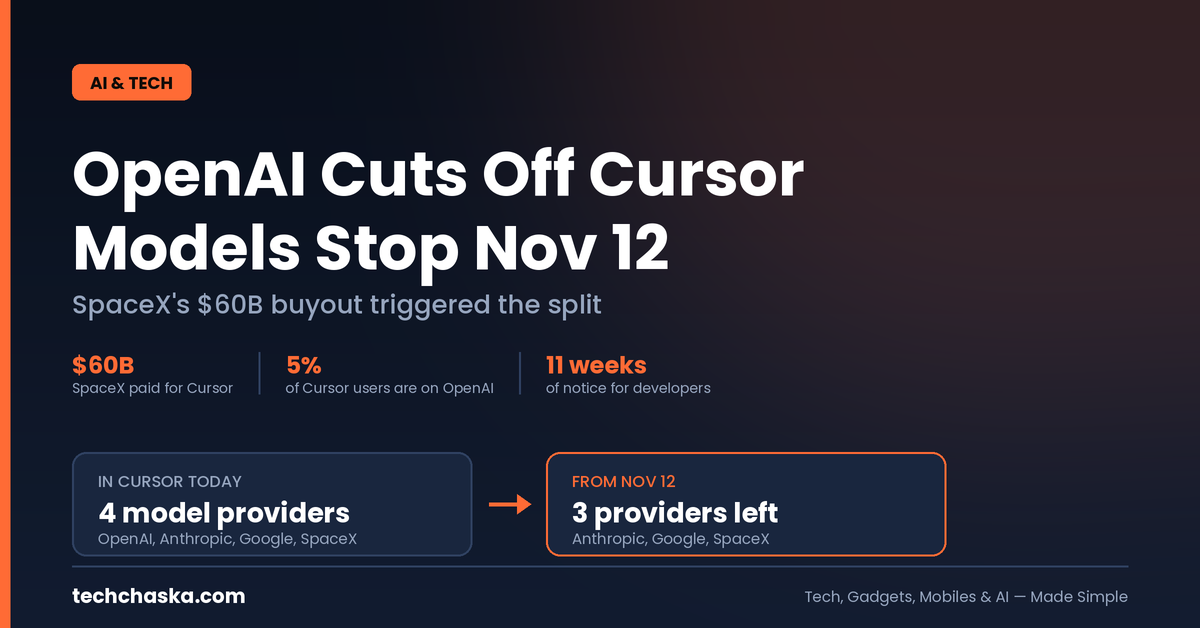
The biggest feud in AI just got a delivery date. On November 12, OpenAI will stop serving its models to Cursor, the AI coding tool that Elon Musk’s SpaceX bought for $60 billion.
This is not a pricing dispute or a quiet contract lapse. OpenAI is publicly saying it does not trust a Musk-owned company to honour its terms of service. And the OpenAI Cursor split is the first time we have seen model access itself used as a weapon between AI giants.
So what actually happened, what breaks for developers, and does any of it matter if you are coding from Bengaluru or Pune? Let me break it down honestly.
What Happened Between OpenAI and Cursor
The OpenAI Cursor timeline is short and it moves fast:
- June 2026: SpaceX agrees to buy Anysphere, the company behind Cursor, for $60 billion in an all-stock deal — the largest startup acquisition on record
- Mid-August 2026: the deal clears regulatory review and closes
- August 29, 2026: OpenAI notifies SpaceX it is terminating the model-supply contract
- November 12, 2026: OpenAI models stop working inside Cursor
Cursor was reportedly running around $4 billion in annual recurring revenue before the acquisition, built in roughly 18 months. It is the tool a very large share of professional developers now write code in.
Why OpenAI Pulled the Plug
The OpenAI Cursor contract was terminated under a change-of-control provision, and OpenAI’s stated reason is trust, not competition. The company said it cannot be confident SpaceX will use its technology within the terms of service, based on its experience with Musk-owned companies violating contracts.
The specific example it points to: Musk’s admission in April 2026 that xAI trained on OpenAI’s outputs through distillation — using one model’s responses to teach another. There was also a court ruling against Musk in May 2026 in the long-running litigation between the two sides.
One detail cuts against the pure-spite reading. OpenAI said it chose to hold the cancellation to the latest date the contract allowed, rather than cutting access immediately. That is roughly eleven weeks of notice for developers to move.
What Cursor Developers Actually Lose
The OpenAI Cursor cutoff removes one option from a tool that offers four. Less than the headlines suggest, and this is the part most coverage buries.
Cursor CEO Michael Truell said OpenAI serves roughly 5% of Cursor’s customers. The other 95% are already on something else. After November 12, Cursor keeps access to:
- Anthropic’s Claude models — already the default for most serious Cursor users, and the subject of an intensifying model race
- Google’s Gemini models, including the fast, cheap tier like Gemini 3.7 Flash
- SpaceX’s own AI models, which is presumably the whole point of the acquisition
Anthropic went out of its way to be warm about it publicly, with co-founder Tom Brown saying the company is excited for what comes next for Cursor at SpaceX. When your rival cuts someone off, you send flowers.
The Honest Fine Print
Five percent is a real number, not spin. The OpenAI Cursor fallout is narrow. If GPT models were carrying Cursor, this would be an extinction event. They are not. It is a supplier change, and an annoying one.
This cuts both ways commercially. OpenAI is walking away from revenue at one of the largest AI coding tools in the world to make a point. That is a cost, not a costless flex.
Nobody has published the contract. The change-of-control reasoning is coming from OpenAI’s own statement and reporting around it. We are taking one side’s characterisation of a private agreement at face value.
The real risk is precedent, not this one cutoff. If model providers can revoke access because of who owns you, then every AI product built on someone else’s API now carries an ownership risk it did not price in.
What the OpenAI Cursor Split Means for Indian Developers
The OpenAI Cursor story lands in a market that matters. India has one of the largest developer populations in the world, and Cursor adoption here has been fast — it is cheap relative to a salaried engineer’s time and it works well on the kind of large legacy codebases Indian services firms maintain.
Practically, for most Indian teams:
- If you are on Claude or Gemini inside Cursor, nothing changes. That is the majority.
- If your workflow is pinned to GPT models, you have until November 12 to switch models or switch tools. Eleven weeks is enough time to do it calmly.
- If you build a product on a single model provider’s API, this is your warning. Multi-provider support stopped being over-engineering and became basic risk management.
Who Should Care?
- Cursor users: check which model you actually have selected. Most of you are already on Claude and will not notice.
- Engineering leads: this is a good week to confirm your team is not single-provider-locked.
- Founders building on AI APIs: read your own terms for change-of-control clauses. They are in there.
- Everyone else: the OpenAI Cursor row is a fight between billionaires. It is entertaining, but it will not change the AI tools you use.
Bottom Line
The OpenAI Cursor cutoff is a bigger deal as a signal than as an outage. Five percent of users move to a different model, on eleven weeks’ notice, inside a tool that already supports three other providers.
What is genuinely new is the principle: OpenAI has established that it will cut off model access based on who owns the customer. Every AI company building on someone else’s models just learned that their supply chain has a political dimension. That lesson outlasts November 12 by years.
FAQ
When does OpenAI stop working in Cursor?
November 12, 2026. OpenAI notified SpaceX on August 29 and chose the latest termination date the contract permitted.
Will Cursor stop working completely?
No. The OpenAI Cursor cutoff affects one provider only — Cursor keeps Anthropic, Google and SpaceX’s own models. Only OpenAI models go away, and they serve about 5% of Cursor’s customers.
Why did OpenAI cut off Cursor?
The OpenAI Cursor contract was ended under a change-of-control clause. OpenAI says it cannot trust a Musk-owned company to follow its terms of service, citing xAI’s admitted use of OpenAI outputs for training through distillation.
How much did SpaceX pay for Cursor?
$60 billion in an all-stock deal for parent company Anysphere, agreed in June 2026 and closed in mid-August. It is the largest startup acquisition on record.