Gemini 3.7 Flash: Google’s Faster, Cheaper AI Explained
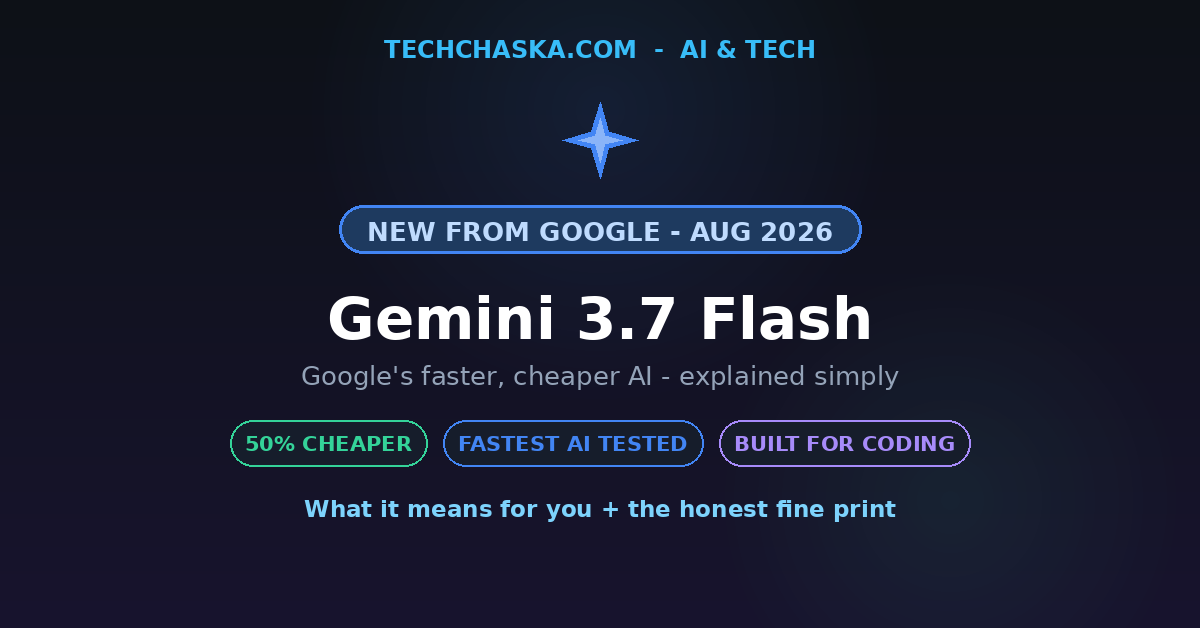
Google just launched Gemini 3.7 Flash, and it continues one of the most striking trends in AI this year: powerful models getting faster and cheaper at a dizzying pace. Released on August 13, 2026 — just 23 days after the previous version — Gemini 3.7 Flash is Google’s new “workhorse” AI, built to be fast, affordable, and especially good at coding and AI “agents” (systems that carry out multi-step tasks on their own). And it arrives with a headline-grabbing 50% price cut. So what exactly is Gemini 3.7 Flash, is it actually a big deal, and what does it mean for you? Let me break it down simply and honestly.
What Is Gemini 3.7 Flash?
First, let’s clear up Google’s naming, which can be confusing. Google’s Gemini AI comes in different tiers:
- “Pro” models — the biggest, smartest, most powerful (and most expensive)
- “Flash” models — the “workhorse” tier: fast, efficient, and cheap, designed for high-volume everyday tasks
Gemini 3.7 Flash is the newest Flash model — the affordable, speedy workhorse rather than the top-end flagship. Think of Flash as the reliable, fuel-efficient car that handles daily driving brilliantly, versus the pricey supercar you only need occasionally. For most real-world AI tasks (coding help, processing documents, running automated workflows), a fast and cheap model like this is exactly what businesses and developers want.
One honest note: Gemini 3.7 Flash isn’t a brand-new AI built from scratch — Google’s own documentation says it’s an improved iteration of the previous 3.6 Flash model. But the improvements are genuinely meaningful, especially for coding.
What’s New and Better
Despite arriving barely three weeks after its predecessor, Gemini 3.7 Flash brings real gains:
- Much better at coding: On a key coding benchmark (DeepSWE), it jumped from 49% to 65.3% — a big leap in debugging and fixing code. This is the headline improvement.
- Smarter AI agents: It’s better at multi-step planning and using software tools, meaning it can handle complex automated tasks with less human hand-holding and fewer errors.
- Better document processing: Improved at reading and understanding complex files like legal and financial documents.
- Blazing fast: Independent testing ranked it the fastest model of 186 tested, at around 340 tokens per second. Speed genuinely matters for real-time apps and agents.
- Modestly smarter overall: On the independent Artificial Analysis Intelligence Index, it scored 56 vs 52 for the previous version — a real, if incremental, gain.
The Big Story: Price
The headline everyone’s talking about is the 50% price cut. Through the end of 2026, Gemini 3.7 Flash costs $0.75 per million input tokens and $3.75 per million output tokens via Google’s API — half what Flash models cost before.
This is part of the huge 2026 theme we’ve been tracking: AI is getting dramatically cheaper as Google, OpenAI, Anthropic, and Chinese labs battle for users. Cheaper AI means developers and businesses can build more, and those savings often reach regular users through better, cheaper apps.
The Honest Fine Print (What Most Coverage Skips)
Now let me give you the balanced picture, because a few important details got buried in the hype:
- The “half price” has an asterisk. That low price is introductory — it expires December 31, 2026, then doubles to $1.50 / $7.50 on January 1, 2027. So the discount is temporary.
- It’s not actually the cheapest. Despite the “cheap” headlines, rivals undercut it: OpenAI’s GPT-5.6 Luna ($0.20 / $1.20) and DeepSeek V4-Flash ($0.14 / $0.28) are both significantly cheaper. Gemini 3.7 Flash competes on the balance of speed, smarts, and price — not on being the absolute cheapest.
- Google also cut the OLD model’s price to match. Google quietly dropped the previous 3.6 Flash to the same introductory rate on the same day — so the “half price” is really about the Flash tier overall, not just the new model.
- Limited consumer access. In the Gemini app, it’s rolling out through “Spark” and currently needs a paid AI Pro or Ultra subscription. Free users stay on the older model for now. And Google’s fine print excludes parts of Europe (the EEA, UK, Switzerland) and Nigeria from the consumer version.
None of this makes it a bad model — it’s genuinely good. It just means the “cheapest, available-to-everyone AI” impression from the headlines isn’t quite the full story.
Who Is This For?
Honest guidance on who benefits:
- Developers & businesses: This is the main audience. If you build apps, coding tools, or AI agents, Gemini 3.7 Flash offers a strong mix of speed, coding skill, and (temporarily) low price. Genuinely worth testing.
- Everyday users: You benefit indirectly. Many apps you use are powered by models like this behind the scenes, so faster/cheaper AI means better, cheaper services for you. If you’re a paying Gemini subscriber, you may get access to it directly.
- Free AI users: Less relevant right now — you’ll stay on the older model unless you subscribe. But competition like this keeps pushing free tiers to improve too.
Why This Matters (The Bigger Picture)
Even if you never touch Gemini 3.7 Flash directly, its release tells you something important about where AI is heading in 2026:
- The pace is relentless. A major new model just 23 days after the last one shows how fast AI is now moving. What’s cutting-edge today is routine in weeks.
- Cheaper AI benefits everyone. The price war between Google, OpenAI, Anthropic, and Chinese labs keeps driving costs down, making powerful AI more accessible to all.
- The focus is shifting to “agents.” Google built this model specifically for AI agents that do tasks for you. That’s the industry’s next big bet — AI that acts, not just answers. See where all the models stack up in our best AI models 2026 ranking.
Bottom Line
Gemini 3.7 Flash is Google’s newest fast, affordable AI workhorse — noticeably better at coding and AI agents than before, incredibly fast, and launched with an eye-catching (if temporary) 50% price cut. It’s a solid, genuinely improved model that continues the 2026 trend of AI getting better and cheaper at breakneck speed.
My honest take: if you’re a developer or business, it’s well worth testing — the coding gains and speed are real. If you’re a regular user, you don’t need to do anything, but you’ll quietly benefit as the apps you use get powered by faster, cheaper AI. Just keep the fine print in mind: the low price is temporary, it’s not the outright cheapest option, and full access needs a subscription. Still, the overall direction — powerful AI becoming faster and more affordable for everyone — is genuinely great news, and Gemini 3.7 Flash is another solid step in that race.
Are you using Google’s Gemini, ChatGPT, or something else for your AI needs? Does cheaper, faster AI change how you’d use it? Let me know in the comments!
More AI reading: our best AI models 2026 ranking, ChatGPT vs Claude vs Gemini, and DeepSeek V4 vs ChatGPT vs Claude. New to AI? Start with what is AI and how to use it. For more, visit our homepage.
Disclaimer: This article is based on Google’s announcements and reporting from VentureBeat, 9to5Google, Android Headlines, and others as of August 2026. Gemini 3.7 Flash launched August 13, 2026. Introductory API pricing ($0.75/$3.75 per million tokens) applies through December 31, 2026, then rises. Availability, features, and pricing may change and vary by region and subscription — verify current details on Google’s official channels.