Meta Says It Just Beat Everyone. In India, You Can’t Use Any of It.
On 12 October, Meta announced its first frontier-class AI models and published benchmarks showing them matching or beating OpenAI and Anthropic. It was the biggest AI launch of the week.
For anyone in India, it was also entirely theoretical. Meta Muse, the assistant these models are built to power, launched in September in the United States only. More than a month later, India is still not on the list, and Meta has not said why.
Here is what was actually announced, where it genuinely lands against the competition, and what the parts you cannot buy here would cost you if you could.
Table of Contents
What Meta actually announced
Two models, previously code-named Watermelon: Muse Wonder and Muse Wonder Full. Meta describes them as its first frontier-class systems, with strong results on agents, memory and coding. They are the engine intended for Meta Muse.
The two headline features are worth understanding because they describe where consumer AI is heading:
- Active Memory — the model retains what you told it across separate conversations, rather than starting fresh each time.
- Active Focus — an agent keeps pursuing a goal when it hits an obstacle, instead of stopping and asking you.
Both are aimed squarely at the agent use case that Meta Muse was built for: an assistant that goes away and does something rather than just answering.
The model they benchmarked is not the model you can buy
This is the part the headlines skipped.
Meta released two models with very different availability. Muse Wonder is on the commercial API at $4 per million input tokens and $20 per million output tokens. Muse Wonder Full — the one in the impressive benchmarks — has no pay-as-you-go API price at all. It is available only through Muse Code subscription tiers.
And on the independent Artificial Analysis Intelligence Index, the gap between them matters:
| Model | Index score | How you get it |
|---|---|---|
| Claude Opus 5.5 | 58 | API |
| Muse Wonder Full | 56 | Subscription only |
| Claude Sonnet 5.5 | 56 | API |
| GPT-6 Astra | 53 | API |
| Gemini 4 Argon | 53 | API |
| Claude Fable 5.1 | 53 | API |
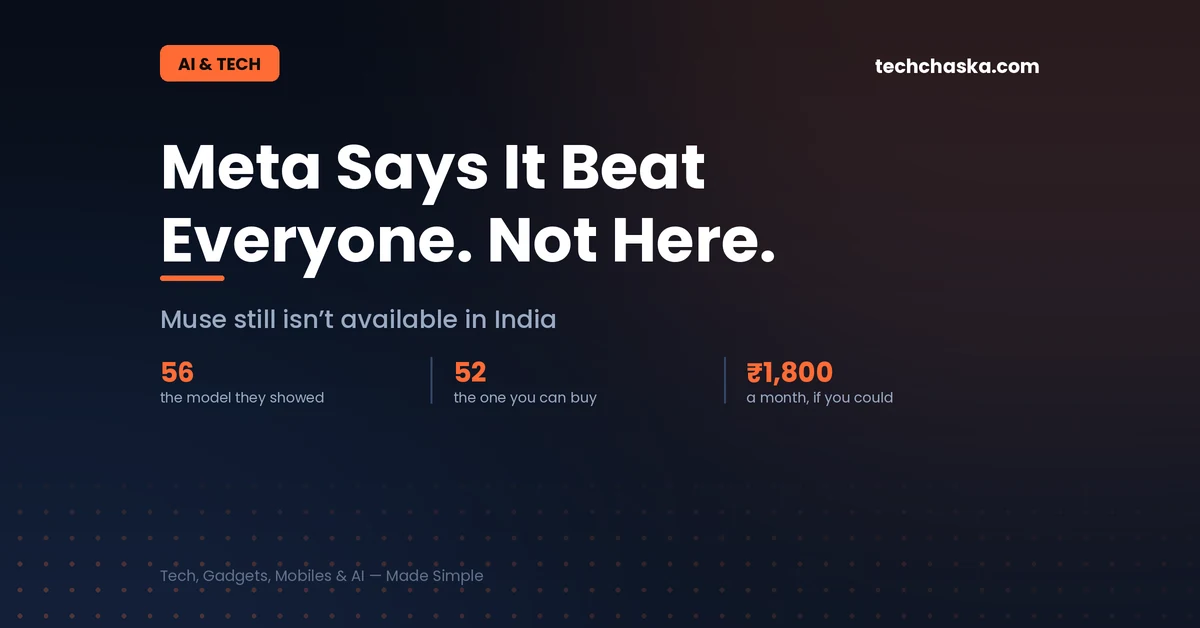
| Muse Wonder | 52 | API |
Read that bottom row again. The Meta model you can actually buy per-token scores below GPT-6 Astra, Gemini 4 Argon and Claude Fable 5.1. The one that beats them is behind a subscription.
That is not fraud, and Meta has not hidden it. But “Meta releases frontier model” and “the frontier model is not on the API” are both true, and only one of them made the headlines.
Where Meta genuinely wins
It would be unfair to leave it there, because Wonder Full does beat the field on several specific tasks. From Meta’s own published comparisons, against GPT-6 Astra and Claude Opus 5.5:
| Benchmark | Wonder Full | GPT-6 Astra | Claude Opus 5.5 |
|---|---|---|---|
| Harvey LAB (legal) | 13.1 | 8.6 | 4.2 |
| SWE-Marathon (long coding) | 57.5 | 42.5 | 46.3 |
| DeepSWE 1.1 | 79.0 | 74.1 | 74.2 |
| Terminal-Bench 4.0-AA | 57.1 | 59.1 | 59.6 |
| HealthBench Pro | 62.3 | 65.3 | 65.6 |
On long-running coding work, the lead is real and large. On the legal benchmark it more than triples Anthropic’s score — though note that every score there is low in absolute terms, which tells you these systems are still some way from doing legal work you would rely on.
It loses on terminal tasks and on health.
The benchmark card has a problem
One caution before anyone treats those numbers as settled. Meta’s model card mixes three different kinds of result: its own internal evaluations, scores supplied by vendors, and third-party testing. They are not the same thing and are presented together.
Some of the software-engineering comparisons also ran through different coding tools for different models, which means the models were not tested under identical conditions. A benchmark where one competitor uses a better harness is measuring the harness too.
This is why the independent index in the first table is the more useful number, and why it tells a less flattering story than Meta’s own chart.
Meta Muse is still not available in India
Now the part that actually affects you.
Meta Muse launched on 9 September 2026 — on iOS, Android and the web, in the United States. It is an agent rather than a chatbot: it can send emails, fill in forms, negotiate and make purchases, and it keeps working after you close the app. It runs inside a dedicated virtual machine, with a separate “Sentinel” agent that has to approve anything it sends out to the internet.
India was not in the rollout. Meta gave no reason. MediaNama put questions to Meta’s India policy and communications teams and, as of publication, had no response.
That silence is the story. India is Meta’s largest user base by a wide margin. An assistant that books and buys on your behalf is exactly the product you would expect to see tested here first. Instead the launch skipped the country entirely, and the company will not say whether that is about regulation, cost, payments, or something else.
The new models change nothing about this. Meta says Muse Wonder will power future Meta Muse experiences, initially for paid subscribers — in the markets where Muse exists.
What Meta Muse would cost you
For completeness, since this is the pricing nobody converts into rupees:
| Product | Price |
|---|---|
| Meta Muse (consumer) | Free tier, plus $20 and $100 per month |
| Muse Code — Power Usage | $50 per month (20× the Everyday allowance) |
| Muse Code — Maximum Usage | $200 per month (80× the Everyday allowance) |
| Muse Wonder API | $4 per million input tokens, $20 per million output |
The $20 consumer tier is roughly ₹1,800 a month at current rates. For comparison, ChatGPT Go costs ₹399 a month in India and Google AI Pro is bundled free for eighteen months with qualifying Jio plans.
That comparison is the real reason to care about the India gap. Meta Muse is not just absent — it would be arriving into a market where its nearest rivals have spent a year giving the product away.
If you want Meta Muse in India today
You cannot have Meta Muse, and we would not suggest routing around a geographic restriction to get it. What you can have:
- Agent features already in India. Both ChatGPT and Gemini now do multi-step tasks and shopping assistance in the Indian market.
- Muse Wonder through the API. The model is available commercially even where the consumer app is not — relevant if you are building something, not if you want an assistant on your phone.
- Patience. Meta has not said India is excluded permanently. It has not said anything.
We looked recently at AI agents that shop on your behalf and at the free AI year that is now ending in India. On the rules side, India’s AI content rules already apply to you.
The Honest Fine Print
We have not tested any of these models. Every number here is from Meta’s published materials or from third-party benchmarking. We have run nothing ourselves.
The index and Meta’s chart disagree, and we have shown both. The Artificial Analysis index puts Wonder Full second; Meta’s own card has it winning several benchmarks outright. Both can be true — they measure different things — and we are not in a position to adjudicate.
Benchmark scores age in weeks. These standings reflect mid-October 2026. New releases reshuffle them constantly, and anyone citing this table in three months should check it again.
The India exclusion is reported, not confirmed by Meta. Our basis is that India was absent from the launch markets and that Meta did not respond to press questions about it. We have not seen a statement saying India is excluded, because there is no statement at all.
Rupee figures are approximate. We converted the dollar prices at current rates to give you a sense of scale. Actual billing, taxes and card charges would differ.
We have not verified the Muse security architecture. The virtual machine and the Sentinel approval agent are as Meta describes them. Whether they work as stated is not something anyone outside the company can confirm yet.
Bottom Line
Meta built something genuinely competitive. On long-running coding tasks it appears to lead the field, and Active Memory is the kind of feature that quietly changes how useful an assistant is.
But the version on open sale scores below three rivals, the version that beats them needs a subscription, and the consumer product the whole thing is for has not reached the country with more Meta users than any other.
If you are in India, the practical answer today is that this launch does not affect you. The interesting question is why a company this invested in India launched Meta Muse, its most ambitious consumer product, everywhere but here — and declined to explain.
FAQ
Is Meta Muse available in India?
No. Meta Muse launched on 9 September 2026 in the United States only, on iOS, Android and the web. India was not included, Meta has given no reason, and it has not responded to press questions about availability here.
What is Meta Muse?
An AI agent rather than a chatbot. It can send emails, fill forms, negotiate and make purchases on your behalf, and continues running after you close the app. It operates in a dedicated virtual machine, with a separate Sentinel agent approving anything it sends to the internet.
What are Muse Wonder and Muse Wonder Full?
Meta’s first frontier-class AI models, announced 12 October 2026. Wonder is on the commercial API; Wonder Full is the stronger model and is only available through Muse Code subscriptions, with no pay-as-you-go pricing.
Is Muse Wonder better than GPT-6 or Gemini?
It depends which one. On the independent Artificial Analysis index, Wonder Full scores 56 against 53 for GPT-6 Astra and Gemini 4 Argon, but the API-available Muse Wonder scores 52 — below both. Claude Opus 5.5 leads at 58.
How much does Meta Muse cost?
Meta Muse has a free tier plus paid tiers at $20 and $100 a month, roughly ₹1,800 and ₹8,900 at current rates. Muse Code, for developers, runs $50 or $200 a month.
Can I use Meta Muse with a VPN in India?
We are not going to recommend that. Beyond the terms-of-service question, an agent that makes purchases and sends messages on your behalf is not something to run through a workaround in an unsupported market.
When will Meta Muse launch in India?
Unknown. Meta has not announced a date, has not said India is excluded permanently, and has not commented at all.
Sources: the model launch via Axios and TechCrunch; benchmark index, API pricing and model-card caveats via VentureBeat; the India availability gap via MediaNama.