India’s AI Content Rules Already Apply to You
On 8 October, IT Minister Ashwini Vaishnaw said India will publish a consultation paper on regulating AI content within thirty days. That got the headlines.
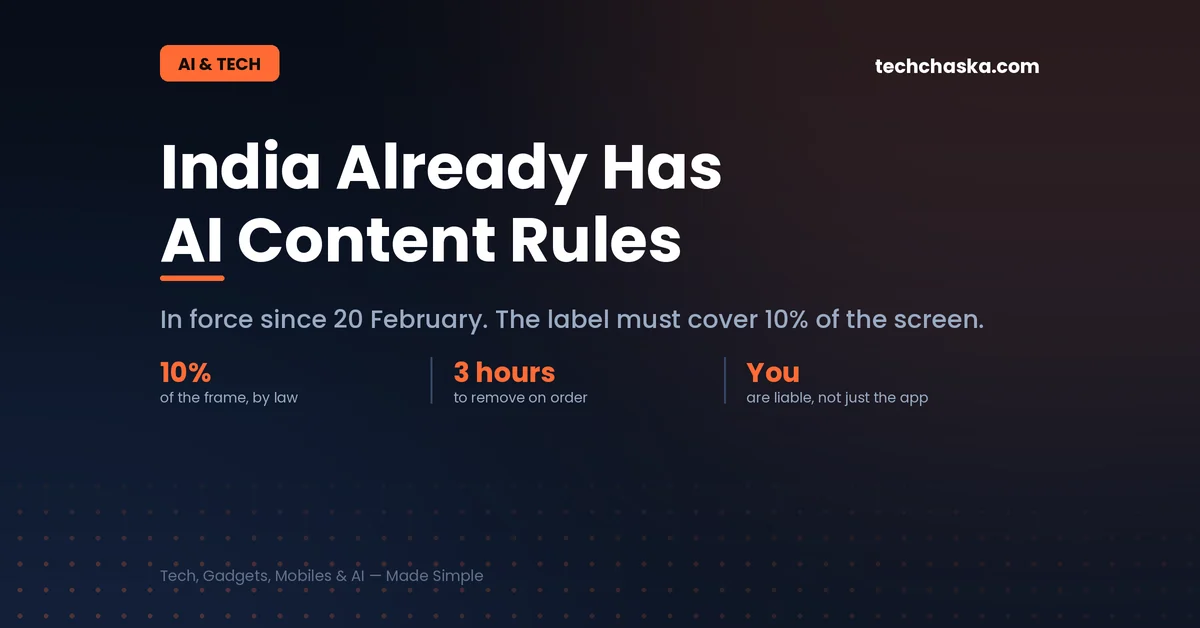
Here is what mostly did not: India has had binding rules on AI content since 20 February 2026. They require a visible label covering 10% of the screen. They apply to you, not just to platforms. And they can get your account terminated and your identity handed to the person you deceived.
The consultation paper is a year or more from becoming law. The rules below are live today.
Table of Contents
The AI content rules already in force
The Information Technology (Amendment) Rules, 2026 were notified on 10 February and took effect on 20 February, with a ten-day compliance window. They introduce a category called synthetically generated information, or SGI.
SGI is the legal term for AI content: audio, visual or audio-visual material artificially or algorithmically created or altered so that it appears real and authentic. The test is whether it could be mistaken for a genuine person or event.
| Obligation | Requirement |
|---|---|
| Visual label | Must cover 10% of the surface area |
| Audio label | Must occupy 10% of the opening duration |
| Metadata | Permanent provenance markers with a unique identifier; platforms may not allow removal |
| Takedown on government or court order | 3 hours (down from 36) |
| Sexually explicit content | 2 hours |
| User-flagged content | 7 days |
| User reminders | Platforms must notify users of these obligations every 3 months |
Platforms with more than 50 lakh registered users in India carry extra duties. They must ask users to declare whether what they are uploading is synthetic, and deploy technical measures to check those declarations rather than taking the user’s word for it.
The 10% label nobody mentions
A label covering a tenth of the visible frame is not a discreet corner watermark. On a vertical video that is a substantial band. On a square image it is roughly a third of the width across the bottom.
For audio the requirement lands differently again: the disclosure has to occupy the first 10% of the clip. On a three-minute track that is eighteen seconds before the content starts.
Whether platforms are applying this consistently is a separate question, and in our experience they are not. But the obligation exists, and it is the most concrete thing anyone has written down about AI content in India.
What counts as AI content, and what does not
The rules carve out ordinary editing, which matters if you were worried that using any tool makes you liable.
Not covered: good-faith technical edits such as formatting, colour adjustment, noise reduction and compression. Drafts and templates. Documents and educational material that do not create a false record. Tools used purely for accessibility, translation or discoverability.
Covered: material generated or altered so it appears to be a real person or a real event when it is not.
Then there is a prohibited tier, where labelling is not a defence at all. That covers child sexual exploitation material, non-consensual intimate imagery, obscene content, false documents and records, synthetic depictions of explosives and weapons, and deceptive portrayals of real people or events. Platforms offering generation tools must deploy automated measures to stop this material being made in the first place.
You are liable too, not only the platform
This is the part most coverage of Indian AI content regulation skips, because the reporting is written for compliance teams rather than for people who post things.
A user who uploads prohibited or mislabelled AI content can face:
- Immediate removal of the content
- Suspension or termination of their account
- Disclosure of their identity to the victim
- Mandatory reporting to the authorities
- Penalties under the IT Act and other laws
That third one deserves a second look. If you make a convincing fake of someone and they complain, the framework contemplates the platform telling them who you are. The anonymity people assume they have when posting a face-swap is not what the rules assume.
What Vaishnaw actually announced this week
Now the news everyone led with, in proportion.
Speaking at the World Bank’s World Development Report release in New Delhi on 8 October, Vaishnaw said a consultation paper would be ready within a month, putting it around early November. He said safety would be its most important element, named deepfakes and user harm as focus areas, and argued for a “techno-legal” approach pairing legal duties with technical safeguards. He said technology companies should carry primary responsibility. He also pointed to a target of procuring 10,000 GPUs for public-interest AI work.
What has not been decided is almost everything that matters: whether India gets a standalone AI law, amendments to existing law, or sector-by-sector rules; which obligations fall on model developers versus platforms versus deployers; and what any of it costs if you breach it. Bodies floated in the governance guidelines — an AI Safety Institute, a Technology and Policy Expert Committee — remain proposals.
A consultation paper is the beginning of a process, not the end. Draft, consultation, revision, drafting of law, passage, rules, enforcement. The realistic horizon is years.
What to do if you post AI content
- Label your AI content, visibly. The standard written into Indian law is 10% of the frame, not a small corner tag. If a platform offers an “AI generated” toggle, use it — that is your declaration.
- Do not strip metadata. Provenance markers are meant to be permanent. Removing them is specifically what the rules prohibit.
- Treat real people as a hard line. Deceptive portrayals of identifiable individuals sit in the prohibited tier, where a label does not help you.
- Assume you are identifiable. The framework contemplates your identity being disclosed to a victim.
- Ordinary editing is fine. Colour grading, noise reduction and compression are explicitly exempt. This is not a rule against using software.
If you are interested in where AI is heading in India more broadly, we looked at AI agents that shop on your behalf this week, and earlier at what AI summaries do to what you remember and which AI phone features actually matter.
The Honest Fine Print
We have not read the notified text. The figures here — 10% coverage, three-hour takedown, 50 lakh user threshold — come from law-firm analyses of the amendment, not from the gazette. Those analyses broadly agree, but if you need this for compliance, read MeitY’s own notification.
Our sources disagreed on one point. Some coverage of this week’s announcement describes India as having no rules on AI content yet. That is wrong — the February amendment is in force — but the disagreement is real and we resolved it by checking separately rather than picking a side.
Enforcement is a different question from the rule. We have seen no data on prosecutions or takedowns under these provisions. A rule that exists and a rule that is applied are not the same thing, and we cannot tell you which this is yet.
The label specifics may vary in practice. The 10% figure appears consistently in legal analysis, but how platforms implement it — and whether a platform’s own tag satisfies it — is not something we can confirm from outside.
Vaishnaw’s remarks are paraphrased. The reports we used do not carry extended direct quotes. We have described the substance as reported rather than putting words in quotation marks.
This is not legal advice. It is a description of published rules. For anything consequential, speak to a lawyer.
Bottom Line
India did not start regulating AI content this week. It started on 20 February, and the rules are more specific than the announcement that replaced them in the headlines: a label across a tenth of the frame, three hours to comply with a takedown order, and consequences that reach the person who posted, not just the company that hosted.
The consultation paper due in November matters for where this ends up. It changes nothing about what applies tonight.
If you make or share synthetic media in India, the useful question is not what the law might say next year. It is whether the thing you posted last week carried a label covering 10% of the screen.
FAQ
Is AI content legal in India?
Yes, with conditions. Under the IT Amendment Rules 2026, in force since 20 February, synthetic audio and visual material that appears real must be labelled and carry permanent provenance metadata. A prohibited tier — including non-consensual intimate imagery and deceptive portrayals of real people — is not permitted at all, labelled or otherwise.
How big must an AI content label be in India?
Legal analyses of the amendment put it at 10% of the visual surface area, and for audio, 10% of the opening duration. That is a prominent band rather than a corner watermark.
What is synthetically generated information?
It is the legal term for AI content: audio, visual or audio-visual material artificially or algorithmically created or altered so that it appears real and authentic. Routine edits such as colour correction, noise reduction and compression are exempt, as are drafts, templates and accessibility tools.
How fast must platforms remove illegal AI content?
Three hours from a court or authorised government order, reduced from 36 hours. Sexually explicit material has a two-hour window, and user-flagged content seven days.
Can I be penalised personally for posting a deepfake?
Yes. Consequences for users include content removal, account suspension or termination, disclosure of your identity to the victim, reporting to authorities, and penalties under the IT Act and other laws.
What did the government announce in October 2026?
On 8 October, Ashwini Vaishnaw said an AI regulation consultation paper would be published within thirty days, focused on safety, deepfakes, user harm and skilling, alongside a target of 10,000 GPUs for public-interest AI. It is a consultation paper, not a law.
When will India have a full AI law?
Unknown. No decision has been taken on whether rules for AI content will come as a standalone law, amendments to existing legislation, or sector-specific regulation. A consultation paper is the first step of a multi-year process.
Sources: analysis of the IT Amendment Rules 2026 via Hogan Lovells and Mondaq; the October announcement via The420 and Organiser. These are secondary analyses; the notified text sits with MeitY.