What “10% Instant Discount” Actually Pays You
Both festive sales are now running, and the same five words are on every banner: 10% instant discount with your bank card.
We read the actual terms. Axis Bank publishes a PDF for the Flipkart sale, and it runs to seven different caps. Depending on which invisible category your purchase falls into, that “10%” pays you anywhere from ₹100 to ₹10,000.
Same banner. Same percentage. A hundredfold difference in what you actually get. Here is how to work out which one applies to you.
Table of Contents
What the instant discount actually pays, by category
These are Axis Bank’s published caps for the Flipkart sale running 8–18 October. The headline is 10% throughout.
| Category | Minimum spend | What you actually get |
|---|---|---|
| Minutes (quick commerce) | ₹1,000 | Flat ₹100 |
| Grocery | ₹2,500 | Flat ₹150 |
| Lifestyle | ₹1,500 | 10%, max ₹750 |
| Mobiles 1 | ₹4,990 | 10%, max ₹1,000 |
| Mobiles 2 | ₹4,990 | max ₹1,250 (₹1,500 on EMI) |
| Mobiles 3 | ₹4,990 | max ₹1,500 (₹1,750 on EMI) |
| Products from ₹44,990 | — | Flat ₹2,000 (₹2,500 on 6+ month EMI) |
| Products from ₹79,990 | — | Flat ₹10,000 |
Read the bottom two rows carefully, because they cut both ways.
If you are buying something expensive — a flagship phone at ₹79,990 or more — the instant discount is genuinely large. ₹10,000 flat is real money and considerably better than 10% capped at ₹1,500.
But if you are buying a ₹20,000 phone, that same banner pays you ₹1,000 to ₹1,750. Not ₹2,000. The percentage stopped mattering the moment you crossed the cap, which on a ₹20,000 purchase happens at around the ₹10,000 mark.
The instant discount number that is not the number
Axis quotes a cumulative base cap of ₹17,250 per card across the whole sale. Amazon’s SBI offer quotes ₹13,750.
Those are the figures that end up in headlines, and they are the most misread numbers of the season. They are not the instant discount on a purchase. They are the maximum the bank will give one card across every transaction between 8 and 18 October.
To actually collect ₹17,250 you would need to make a series of qualifying purchases across multiple categories and multiple offer periods. One phone will not do it. The sale is also split into three windows — 9–10 October, 11–15 October and 16–18 October — with the per-card allowance resetting at ₹1,750 for the first and ₹1,500 for the others.
So the honest translation of “up to ₹17,250” is: not on this purchase.
Your payment method may void the instant discount entirely
This is the part that catches most people, and it is buried deepest.
For the Axis offer on Flipkart, the following do not qualify for the instant discount at all:
- UPI — excluded outright
- Debit cards — excluded
- Net banking — excluded
- Cash on delivery — excluded
- The Flipkart Axis Bank Credit Card itself — excluded from the main offer, though it does work for EMI
Amazon’s SBI offer is structured differently but has its own exclusions: the Cashback SBI Card, the Flipkart SBI Card and the Paytm SBI Card do not qualify, and RuPay credit cards paid through UPI are out. SBI debit cards do get 10%, but only on full payment, capped at ₹9,000, with debit EMI excluded.
If you were planning to pay by UPI because of the discount, check which offer you are actually chasing. We wrote about UPI versus card offers earlier this week; this is the hard confirmation that on Flipkart’s Axis offer, UPI is simply not in it.
Two traps in the fine print
Exchange value is deducted before the minimum is checked. SBI’s terms state the minimum transaction is measured net of exchange. So a ₹6,000 phone paid partly with a ₹2,000 exchange becomes a ₹4,000 transaction — below the ₹4,990 mobile minimum, and the instant discount disappears. The exchange bonus can cost you the bank discount.
A partial return can claw the instant discount back. Axis’s terms are explicit: if a return drops your cart below the qualifying minimum, the order is disqualified and the discount is deducted from your refund. Buying three things together to clear a threshold, then returning one, can leave you worse off than buying them separately.
How to work out your actual number in two minutes
- Find the price bracket first. Above ₹79,990 is a different offer from ₹44,990–₹79,989, which is different again from everything below. The brackets matter far more than the percentage.
- Open the offer terms link on the product page. It is there, it is small, and it holds the only figure that matters. If the page does not name a cap, assume the lowest one in its category.
- Check your exact card is not on the exclusion list. Co-branded cards are excluded surprisingly often, including the ones branded for that very platform.
- Decide exchange or bank offer, not both on autopilot. Work out whether the exchange value pushes you under the minimum before accepting it.
- Then compare against the price, not the badge. Our pieces on reading a festive discount and on what box MRP does to a percentage cover the other half of this.
For the specific models on offer, our running notes on Big Billion Days phone deals track what is actually listed.
Did our earlier pieces hold up?
We said on 4 October that festive discounts are calculated against a reference number that moved, and that an instant discount is capped in ways the banner does not show. Both have held.
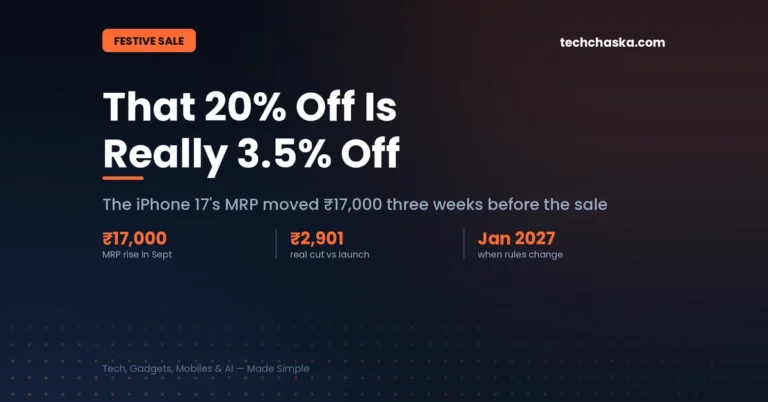
The iPhone 17 is the clearest test. It launched in India at ₹82,900 for 256GB in September 2025. Apple raised the price to ₹99,900 in September 2026. Flipkart’s sale price starts at ₹79,999. Against the current MRP that reads as roughly 20% off; against what the phone actually sold for a year ago it is about ₹2,900.
Where we were wrong was about caps being uniformly small. They are not. On a purchase above ₹79,990 the flat ₹10,000 is a serious discount, and anyone who skipped the bank offer on our earlier advice would have lost money. The accurate claim is narrower: the caps vary enormously and the banner tells you nothing about which one you are in.
The Honest Fine Print
These figures come from Axis Bank’s published terms for this sale and from reporting of SBI’s terms. They apply to those two offers only. ICICI and several other participating banks had not published comparable caps at the time of writing, which is itself worth noting.
Offers change mid-sale. The Axis base offer refreshes on 11 and 16 October, and category assignments can move. A cap we have quoted may not be the cap on the day you buy. Check the terms link on the product page.
We could not see the category buckets. “Mobiles 1”, “Mobiles 2” and “Mobiles 3” are the bank’s internal groupings. Which phone sits in which is not shown to shoppers, so we cannot tell you where any specific model falls.
Deal prices quoted by third-party sites disagree with each other. We saw the same iPhone 17 listed at ₹79,999 and at ₹77,999 depending on which offers the site assumed. We have used Flipkart’s own announced starting price.
We corrected ourselves twice this week. Our OPPO F35 and Vivo V80 pieces both carried numbers from pre-launch leaks that did not survive the launch. Both have been corrected and the corrections are visible in those posts. We have stopped building headline claims on leaks.
No affiliate links, no paid placement. We earn nothing whichever card you use.
Bottom Line
“10% instant discount” is not one offer. On Flipkart’s Axis terms it is at least seven, paying between ₹100 and ₹10,000 depending on a category you cannot see from the product page.
Above ₹79,990, take the instant discount — ₹10,000 flat is the best thing on either platform this week. Between ₹5,000 and ₹45,000, expect ₹1,000 to ₹1,750 and plan accordingly. And if you were going to pay by UPI, debit card or net banking on Flipkart, you are not in the offer at all.
The percentage is marketing. The cap is the deal. It takes two minutes to find and it is the difference between a headline and your actual money.
FAQ
What does 10% instant discount actually mean?
A reduction applied at checkout when you pay with a qualifying card, always subject to a maximum rupee cap. On Flipkart’s Axis offer those caps range from ₹100 on quick commerce to ₹10,000 on products above ₹79,990.
What is the maximum instant discount in the Flipkart sale?
Axis Bank publishes a flat ₹10,000 on products from ₹79,990, and ₹2,000 (₹2,500 on 6+ month EMI) on products from ₹44,990. Most mobile categories are capped between ₹1,000 and ₹1,750.
Is the ₹17,250 figure what I save on one purchase?
No. That is the cumulative maximum one Axis card can earn across all transactions from 8 to 18 October, spread over three offer periods. A single phone will not reach it.
Does UPI qualify for the instant discount?
Not on Flipkart’s Axis offer — UPI, debit cards, net banking and cash on delivery are all excluded. On Amazon’s SBI offer, RuPay credit cards paid through UPI do not qualify either, though SBI debit cards get 10% capped at ₹9,000 on full payment.
Can an exchange offer cost me the bank discount?
Yes. SBI’s terms measure the minimum transaction net of exchange value, so a large exchange can push your transaction below the ₹4,990 mobile minimum and void the discount entirely.
What happens to the discount if I return part of my order?
Axis’s terms state that if a return takes the cart below the qualifying minimum, the order is disqualified and the discount is recovered from your refund.
Why is my card not getting the instant discount?
Check the exclusion list. The Flipkart Axis Bank Credit Card is excluded from Axis’s main instant discount, and the Cashback SBI Card, Flipkart SBI Card and Paytm SBI Card are excluded from SBI’s. Corporate and commercial cards are excluded on both.
Sources: Axis Bank’s published terms and conditions for the Flipkart Big Billion Day sale offer on Axis Bank cards; SBI offer terms as reported by PickMyCard; iPhone India pricing via IBTimes India. Offer terms change during sales — verify on the product page before paying.