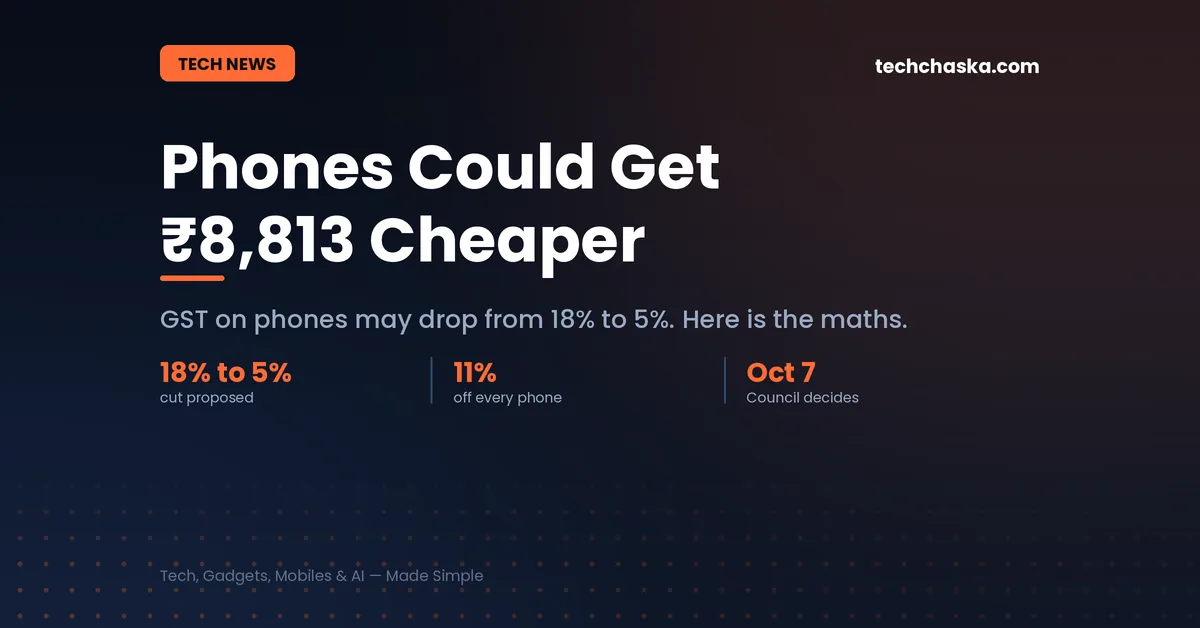
GST on Mobile Phones May Drop to 5%: What You Would Save
The GST on mobile phones in India is 18%. The industry has just formally asked the government to cut it to 5%.
If that happened, every phone you can buy today would get roughly 11% cheaper overnight. On a ₹79,999 Galaxy S26 FE that is ₹8,813 back in your pocket.
Here is what has actually been asked for on GST on mobile phones, what it would save you on real phones, when a decision could come, and whether any of this is a reason to delay a purchase.
Table of Contents
The GST on mobile phones cut: what has been asked for
On 2 September 2026, the India Cellular and Electronics Association — the body that speaks for Apple, Xiaomi, Oppo, Vivo and Lava — wrote to Finance Minister Nirmala Sitharaman and IT Minister Ashwini Vaishnaw asking for the GST on mobile phones to be cut from 18% to 5%. The request covers phone components too.
ICEA chairman Pankaj Mohindroo’s argument is that phones have stopped being a luxury purchase. Today they are how people bank, study, see a doctor and reach the government — and at 18%, he says, “the burden falls most heavily on rural households, lower-income consumers and first-time smartphone buyers.”
The association also points out that when GST arrived in 2017, the combined excise duty and VAT it replaced averaged about 6%. The GST on mobile phones has roughly tripled since, on a product that has become far more essential, not less.
Why GST on mobile phones is being questioned now
Because Indian phone prices have gone up sharply this year, and the industry is feeling it.
- Entry-level prices are up 35–45% in the past year
- Phones under ₹10,000 now account for less than 5% of industry supply
- Handset consumption has fallen and replacement cycles have lengthened — people are keeping phones longer because new ones cost more
The cause is not greed, or not only greed. Memory prices — DRAM and NAND — have risen close to fourfold since September 2025, because AI data centres are buying everything the fabs can make. Qualcomm raised Snapdragon prices by a double-digit percentage from 1 September. This is the same pressure we wrote about in why your next phone will cost more in 2026.
You can see it in this month’s launches. The Redmi Note 17 Pro Max went up 31.6% year on year. The Galaxy S26 FE went up 21.2%. A tax cut is the fastest lever available to offset that, which is precisely why the industry is pulling it.
What a 5% GST on mobile phones would save you
In India, the price on the box already includes GST. So a cut from 18% to 5% does not take 13% off — it takes about 11.02% off, because you are removing tax from a base price, not from the sticker.
The maths, if the GST on mobile phones drops to 5%: new price = old price × (1.05 ÷ 1.18).
| Phone | Price today | At 5% GST | You save |
|---|---|---|---|
| Entry-level 4G | ₹8,999 | ₹8,008 | ₹991 |
| Budget 5G | ₹14,999 | ₹13,347 | ₹1,652 |
| Mid-range | ₹19,999 | ₹17,796 | ₹2,203 |
| Redmi Note 17 Pro | ₹36,999 | ₹32,923 | ₹4,076 |
| Redmi Note 17 Pro Max | ₹49,999 | ₹44,491 | ₹5,508 |
| Galaxy S26 FE | ₹79,999 | ₹71,186 | ₹8,813 |
| iPhone 18 Pro | ₹1,64,900 | ₹1,46,733 | ₹18,167 |
Notice who benefits most in rupee terms: the person buying a ₹1.65 lakh iPhone saves ₹18,167, while the person buying a ₹8,999 phone saves ₹991. The percentage is identical, the absolute amounts are not.
That is worth holding in mind when the change is argued for on the grounds of digital access for the poorest 900 million. It would help them — it would help premium buyers more.
When could GST on mobile phones actually change?
The 57th GST Council meeting is the next opportunity for the GST on mobile phones to change. It was originally set for 12 September and has been rescheduled to 7 October 2026, because India hosted the BRICS summit in New Delhi on 12–13 September. Officers’ meetings run on 5–6 October.
Business Today has reported that the Council may review the 18% rate on handsets at that meeting. Here is the part most coverage skips: a rate change for phones is not formally on the published agenda. The listed items are registration simplification, input tax credit, refunds and compliance. Rate rationalisation was largely finished under GST 2.0 in 2025.
So the honest position is: a trade body has made a request, one credible outlet reports it may be discussed, and the Council has not said it will act.
Should you wait to buy?
Do not wait if you need a phone now. Your current phone dying in October does not care about the GST Council’s calendar. Nothing has been announced, and “may be reviewed” is a long way from “will be cut”.
Waiting three weeks is reasonable if you were already undecided and you are buying something expensive. If you are spending ₹80,000 and the decision lands on 7 October, ₹8,800 is real money for very little inconvenience.
Do not wait if you are buying under ₹15,000. The most you would save is around ₹1,650, and festive-season bank offers on those models routinely beat that anyway. Take the discount that exists over the one that might.
If your budget is tight either way, our guide to the best phone under 20000 covers what that money buys today, at today’s tax rate.
The Honest Fine Print
Nothing has been decided. This is a request from an industry association, not a government announcement. Headlines saying phones “will get cheaper” are describing a proposal.
A cut to the GST on mobile phones is not formally on the 7 October agenda. It could be taken up, referred to a committee, deferred, or not discussed at all. Any of those is a realistic outcome.
Manufacturers may not pass on all of it. Component costs are still climbing. A brand absorbing a 4x memory price rise could quietly keep part of a tax cut rather than drop the sticker by the full 11%.
The industry has an obvious interest here. ICEA represents the companies that sell the phones. Their case may well be right — the price rises and the demand dip are real and independently reported — but a letter to the Finance Minister is an advocacy document, not a neutral analysis.
Existing stock is unlikely to be repriced retroactively. If a lower GST on mobile phones is announced, expect it to apply from a notified date. Nobody is refunding you for a phone bought in September.
Bottom Line
The GST on mobile phones could fall from 18% to 5%, which would make every handset in India about 11% cheaper. The industry has asked for it, the timing makes sense, and the next realistic decision point is the GST Council on 7 October 2026.
But it has not been agreed, it is not on the formal agenda, and the people asking for it are the people selling you the phone.
If you are buying something expensive and you can hold three weeks, hold. Otherwise buy the phone you need and do not organise your life around a tax proposal.
FAQ
What is the current GST on mobile phones in India?
18%. It applies to the phone and to most accessories sold with it, and it is already included in the MRP you see on the box.
How much cheaper would phones be if GST on mobile phones drops to 5%?
About 11% cheaper, not 13%. Because MRP already includes tax, the new price works out to the old price multiplied by 1.05 ÷ 1.18 — roughly ₹2,200 off a ₹19,999 phone and ₹8,813 off a ₹79,999 one.
When will the GST on mobile phones be decided?
The 57th GST Council meeting on 7 October 2026 is the next opportunity. A rate change for handsets is not on the published agenda, so there is no guarantee it will be taken up.
Should I wait until October to buy a phone?
Only if you are buying something expensive and you were undecided anyway. For phones under ₹15,000 the potential saving is small enough that current festive bank offers are usually the better deal.
Sources: Business Standard, Outlook Business, Deccan Chronicle. Savings figures are our own calculations from GST-inclusive MRPs current at the time of writing. No rate change has been announced.