MG Battery as a Service: The Maths Works, the Contract Is Missing
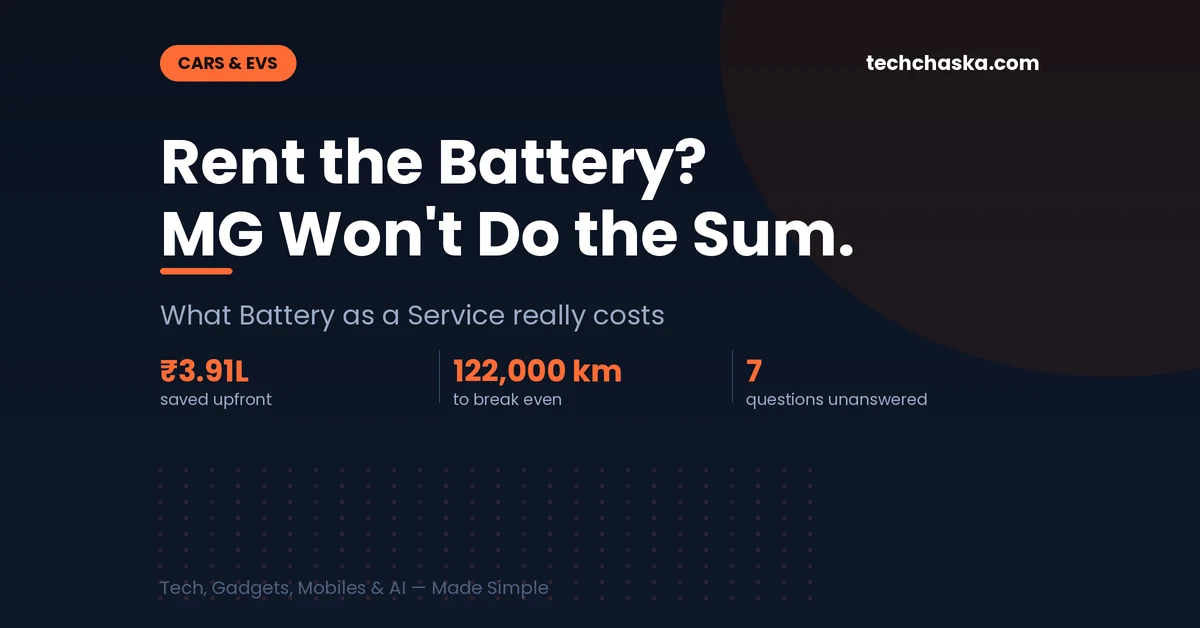
MG will sell you a Hector Tomahawk PHEV for ₹21.79 lakh instead of ₹25.70 lakh. You save nearly four lakh rupees up front. The catch is that you do not own the battery — you rent it, at ₹3.20 for every kilometre you drive.
This is Battery as a Service, and MG is now pushing it across its range in India. The arithmetic is genuinely interesting and, for most Indian drivers, it works out in your favour. The problem is everything MG has not told you.
We went looking for the contract terms. We could not find them. Not on MG’s website, not in their FAQ, not in the one PDF they publish about resale value. Seven basic questions, no answers anywhere.
Table of Contents
What Battery as a Service actually costs
Here is MG’s current line-up with both prices side by side, ex-showroom:
- Hector Tomahawk PHEV — ₹21.79 lakh + ₹3.20/km, or about ₹25.70 lakh outright
- Hector Tomahawk EV — ₹13.99 lakh + ₹4.90/km, or about ₹19.49 lakh outright
- Windsor — ₹9.99 lakh + ₹4.30/km
- Windsor Pro — ₹12.25 lakh + ₹4.60/km
- Windsor Indulge — ₹13.14 lakh + ₹4.30/km
Notice something odd. The PHEV’s battery rental is the cheapest per kilometre at ₹3.20, while the full-electric Hector’s is the dearest at ₹4.90. That is not a mistake — the EV carries a 69.2 kWh pack against the PHEV’s 20.5 kWh, so the bigger battery costs more to rent. The cheaper-looking car has the more expensive meter running.
The Battery as a Service break-even sum nobody is publishing
The only question that matters here is simple: at how many kilometres does the rent you have paid exceed the money you saved?
Hector Tomahawk PHEV. You save ₹3.91 lakh up front. At ₹3.20 per kilometre, that is ₹3,91,000 ÷ 3.20 = about 122,000 km.
Hector Tomahawk EV. You save ₹5.50 lakh. At ₹4.90 per kilometre, that is ₹5,50,000 ÷ 4.90 = about 112,000 km.
Now put that against how Indians actually drive. At a fairly typical 12,000 km a year, the PHEV takes ten years to reach break-even. At 15,000 km a year it still takes over eight. Most people will have sold the car long before the rental catches up with the discount.
Put another way: at 12,000 km a year you are paying ₹38,400 annually to rent the PHEV battery. Over five years that is ₹1.92 lakh — against ₹3.91 lakh you did not spend on day one. You are roughly two lakh rupees ahead, before you even count what that money earned sitting in your account or not accruing loan interest.
On the arithmetic alone, Battery as a Service is the better deal for most buyers. We want to be clear about that before the rest of this article, because what follows is going to sound sceptical.
Seven Battery as a Service questions MG has not answered
We read MG’s official Hector Tomahawk PHEV page, their FAQ, and the terms document they publish about depreciation. Between them, here is what we could not establish.
1. Is there a minimum charge?
If you drive 400 km in a month, do you pay ₹1,280 — or is there a floor you pay regardless? Every usage-based contract we have seen in other industries has one. MG does not publish whether theirs does.
2. How long does the contract run, and what happens at the end?
No tenure is stated anywhere. Does the rental run for three years, five, or for as long as you own the car? And when it ends, do you own the battery, return the car, or start a new agreement at whatever rate applies then?
3. Can you buy the battery later, and for how much?
A buyer who later decides renting was a mistake has no published way out and no published price. If a buyout exists, MG has not said so.
4. What happens when you sell the car?
This is the big one. You are selling a car with a rental contract attached to its most expensive component. Does the agreement transfer to the buyer? Does the buyer have to qualify? What happens if they refuse? Nothing on this is published, and it directly determines what your car is worth second-hand.
5. Who pays when the battery degrades?
MG’s 3-3-3 package covers three years of unlimited-kilometre warranty, roadside assistance and labour-free servicing. Whether the battery falls under that warranty is not stated. Logically a rented battery should be MG’s problem, since MG owns it — but “logically” is not a contract. Who insures it is also unstated.
6. What happens if you miss a payment?
No penalty terms are published. Nor is there any statement about whether a Battery as a Service car can be remotely limited or immobilised for non-payment. MG does advertise “24×7 Battery Management System monitoring” as a feature, which means the connectivity to do it exists. That is not an accusation — it is an unanswered question.
7. Does ₹3.20 stay ₹3.20?
MG describes its prices as introductory. If the per-kilometre rate can rise with inflation or at MG’s discretion, every break-even calculation in this article is provisional — including ours.
About those “introductory” prices
MG’s own page says prices are introductory, and reporting on the launch described them as applying to a limited number of bookings. The Tomahawk crossed 10,000 bookings by mid-October, with the figure attributed to JSW MG Motor India’s sales director.
So a reasonable question for anyone booking now is whether the introductory price is still live, and what the car costs once it is not. MG has not published the threshold, so nobody outside the company can tell you. Ask the dealer in writing, and get the price confirmed on the booking form rather than in conversation — the same discipline we applied to festive sale discount caps.
The one document MG publishes about resale, and what it does not say
MG links a PDF titled “Windsor Depreciation Terms & Conditions”. We read it, expecting the resale answers.
It is not a depreciation policy. It is a two-paragraph disclaimer attached to an advertising campaign for the Windsor Pro, headlined around keeping 84% of what you paid over three years. The document never states the buyback amount, never gives a formula, never names the partner running it, and lists no eligibility conditions — no kilometre cap, no service-history requirement, nothing. It also states that the illustrations do not represent a guaranteed resale value.
Battery as a Service is not mentioned in it at all. Neither is the Hector Tomahawk. So MG’s only published document about what your car will be worth later does not apply to the car in this article, and does not address the rental that is attached to it.
Delivery and waiting on Battery as a Service cars, as of today
EV deliveries began in September. PHEV deliveries were scheduled to start in November — and as of today, 12 November, we could not find confirmation from any source that they actually have begun. If you are holding a PHEV booking, that is worth a call to your dealer.
Waiting periods are listed as over two months for both PHEV variants, and MG has indicated lead times could exceed eight weeks. Those two statements are roughly consistent, which is more than can be said for the prices: depending on which source you read, the PHEV Exclusive is ₹25.59, ₹25.69 or ₹25.70 lakh. We have used ₹25.70 throughout, and the difference does not change the break-even meaningfully.
So should you take Battery as a Service?
The Battery as a Service maths says yes for most people. If you drive under about 15,000 km a year and expect to keep the car five to seven years, you will almost certainly come out ahead renting. The break-even sits far beyond where you will be.
The unknowns say get it in writing. Before you sign, ask the dealer these in writing and keep the reply: is there a minimum monthly charge, how long does the agreement run, what happens at the end, can I buy the battery and for how much, does the contract pass to a buyer if I sell, who pays if the battery degrades, and can the rate go up.
Think hard if you drive a lot. Commercial use, long highway runs, 25,000 km a year — the break-even arrives in under five years and the sums stop favouring you.
Think hard if you sell cars often. Until MG publishes how the rental transfers, the resale position is genuinely unknown, and unknown is not the same as fine.
The Honest Fine Print
Our break-even numbers are simple arithmetic, not financial modelling. They divide the upfront saving by the per-kilometre rate. They do not account for loan interest on the larger amount, the return you might earn on money you did not spend, insurance differences, or resale impact. Each of those pushes the answer further in favour of renting, except resale, which we cannot calculate because MG has not published the terms.
“Not published” is not “does not exist.” MG almost certainly has full contract terms that a dealer will show you at signing. Our finding is that they are not public, which means you cannot compare before you walk in. That is a criticism of the disclosure, not an allegation about the terms.
Prices disagree across sources. We found the PHEV Exclusive listed at three different figures and the Essence at two. We have used the most commonly cited and flagged it rather than pretending to precision we do not have.
We have not driven the car or seen a BaaS contract. This is a pricing and terms analysis built from published sources. If you have signed one of these agreements and the contract answers our seven questions, we would genuinely like to see it.
We cannot confirm PHEV deliveries have started. November was the stated plan. Today is the 12th. Absence of confirmation is not evidence of delay — it may simply be that nobody has reported it yet.
Frequently Asked Questions
What is Battery as a Service?
You buy the car without its battery and pay to use the battery by the kilometre. On the Hector Tomahawk PHEV that means ₹21.79 lakh instead of about ₹25.70 lakh, plus ₹3.20 for every kilometre driven. MG retains ownership of the battery pack.
Is Battery as a Service cheaper than buying outright?
For most drivers, yes. The PHEV breaks even at roughly 122,000 km and the EV at roughly 112,000 km. At 12,000 km a year that is ten years and nine years respectively — longer than most people keep a car.
Why is the EV’s battery rental more expensive than the PHEV’s?
Because the battery is much larger. The Hector Tomahawk EV carries 69.2 kWh against the PHEV’s 20.5 kWh, so the rental is ₹4.90/km instead of ₹3.20/km despite the car being cheaper to buy.
What happens to Battery as a Service if I sell the car?
Unknown. MG has not published whether the rental agreement transfers to the new owner, whether the buyer must qualify, or how it affects valuation. Ask your dealer in writing before signing.
Does the ₹3.20 per km rate ever increase?
Not stated. MG describes its pricing as introductory but publishes no escalation terms, so whether the rate is fixed for the life of the agreement is a question only the contract can answer.
When do Hector Tomahawk PHEV deliveries start?
November 2026 was the stated plan, with waiting periods listed at over two months. As of 12 November we could not confirm deliveries have actually begun. For current prices and variants, see our MG Hector Tomahawk price breakdown.
Bottom line
Battery as a Service is not a trick. On the numbers MG has published, renting the battery is the better financial choice for the majority of Indian buyers, and comfortably so.
But a car is a five-to-ten-year commitment, and MG is asking you to attach a usage contract to its most expensive component while publishing a per-kilometre rate and nothing else. No tenure, no minimum, no buyout, no transfer terms, no liability split, no escalation clause.
The sums are on your side. The paperwork is the part you cannot see — so make the dealer show you, in writing, before you sign. The same rule applies here as to any price printed on a box: the advertised number is the beginning of the question, not the answer.
Sources
- MG Motor India — official BaaS pricing, variants, the 3-3-3 package and the November delivery plan
- Autopunditz — the 10,000 bookings figure, per-km rates and introductory-price caveat
- ZigWheels — variant prices and the two-month-plus waiting period
- EVShift — booking process and delivery timing
- Carlelo — the 3-3-3 package detail and alternative price figures